
75% of security leaders agree it will take a leader at their organization being personally fooled or impersonated before deepfakes become a genuine boardroom priority.
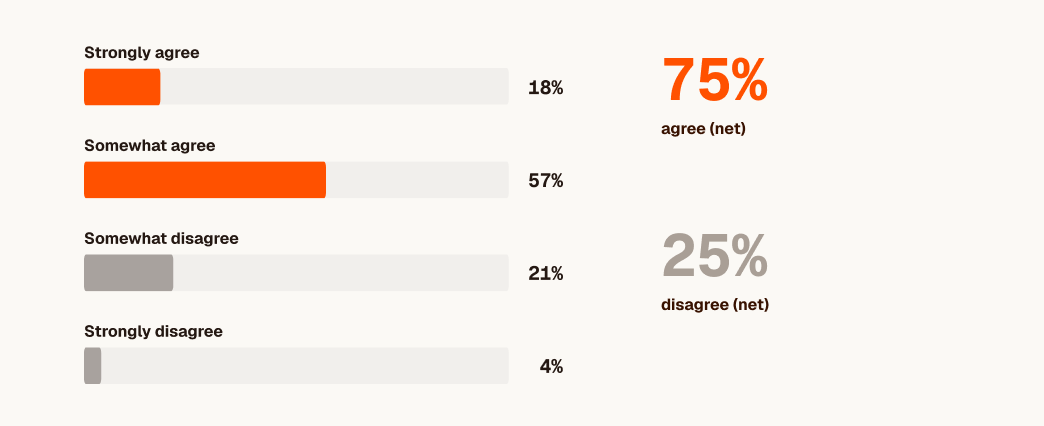
That’s 3 out of 4 security professionals, people who understand the threat most clearly, who don't believe their leadership teams will act until the threat hits home.
It’s possible boardrooms still view deepfakes as a public figure or celebrity issue, one defined by manipulated videos on social media that spread like wildfire and make headlines. That framing made it easy for leadership teams to file deepfakes under "reputational risk for high-profile individuals" rather than "persistent enterprise security threat requiring infrastructure investment." It’s true that incidents that make the news are dramatic and visible. It’s also true that companies face impacts far beyond just reputation—they can face data theft and system intrusion.
PINDROP POV
Deepfakes are simply today’s identity attacks, and need to be treated as such. This means recognizing that the live communication channel is a gap in an otherwise Zero Trust stack, and closing that gap requires the same commitment organizations brought to endpoint protection, cloud security, and identity management.
The next step is getting the board and higher-level leadership to understand the risk in terms they already use: a threat that is active, financially significant, and getting more sophisticated faster than the defenses already in place.
The security leaders prioritizing deepfake detection today are the only ones who'll have a real answer when their board starts to ask questions.Jim Routh, Chairman of The CISO Deepfake Defense Council and former 6X CSO/CISO in financial services and healthcare
Text
1%
Text
Text
1%
Text
Text
1%
Text
Text
Lorem ipsum dolor sit amet consectetur. Sit convallis ullamcorper et varius venenatis blandit vitae hendrerit blandit. Hac aenean tellus consectetur elit orci aenean ipsum arcu. Turpis a laoreet sit rhoncus eros penatibus facilisis dolor tempus. Vitae gravida fames nunc dui scelerisque porta nulla ut. Sit mi volutpat ipsum odio nulla sociis.
Lorem Ipsum is simply dummy
Vitae eleifend mi lorem iaculis malesuada sit adipiscing vel. Sit massa ut etiam eu.