
Most security leaders (93%) report that they’re at least somewhat concerned about deepfake attacks, yet their organizations aren’t rolling out tools that directly address this concern.
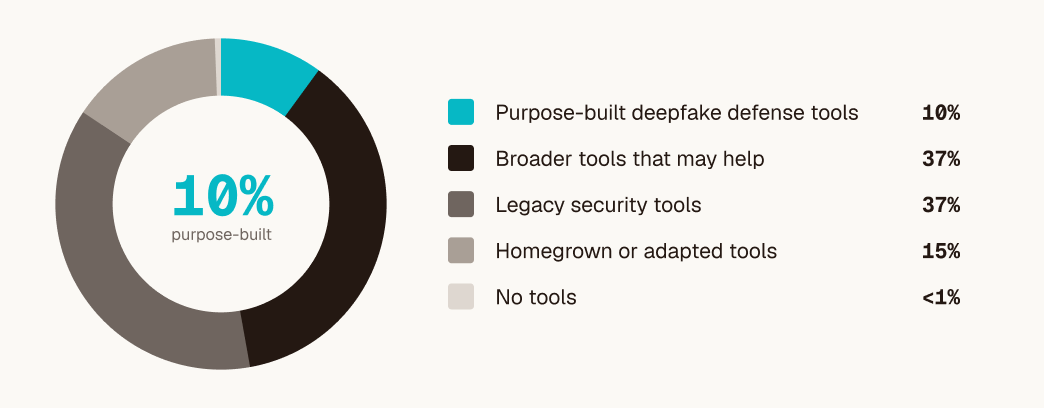
Legacy security tools are no match for the scale and sophistication of today’s deepfake attacks, largely because attacks are happening in channels that these tools weren’t designed to defend.
Real-time communication channels have become a prime target for deepfake and AI-backed impersonation attacks. Without a way to evaluate whether the person on a video meeting or phone call is real, organizations are flying into a danger zone with zero visibility—and attackers know it.
In February 2026, Pindrop reported on this spike in AI attacks. At that time, among the Pindrop customer base, from Q4 2024 to Q4 2025, AI attacks had jumped by 1210%. Just three months later, that number was 1390%. And by the end of June 2026, the growth had reached 1680%. Compared to traditional attack types, AI attacks are growing 8x faster.1
Deepfake detection point-solutions may seem like a promising answer to the crisis. But a point solution is not a long-term solve. AI has created a foundational identity and trust question that requires an equally foundational change in the security strategy for real-time channels. Those channels have now become identity checkpoints—checkpoints where we can’t trust our eyes and ears. That’s exactly why a new layer of defense is needed, one that extends continuous, real-time verification to these vulnerable channels.
For thousands of years, trust was based on perception: recognizing someone’s voice or seeing someone face-to-face. We’re now in an age where trust can be synthesized. AI has changed what we think of as proof.Ajit Gaddam, Head of Fraud, Financial Crimes, and Trust Systems, HealthEquity
The survey also revealed a startling tension. While only a fraction of leaders have invested in purpose-built tools, 74% believe that defenses will improve faster than attack quality. That’s a contradiction; most respondents are at least somewhat concerned, only 10% have invested in a solution, yet three-quarters are optimistic.
PINDROP POV
It’s possible this is a prioritization problem. While there’s real exposure, and respondents know sophisticated tools exist, this attack surface just isn’t prioritized in the boardroom yet.
But for those who prioritized, understood the exposure, and advocated for purpose-built defenses, 52% report a strong return on investment.
Read more: What deepfake detection is and how it works · Best deepfake detection software for enterprises
Text
1%
Text
Text
1%
Text
Text
1%
Text
Text
Lorem ipsum dolor sit amet consectetur. Sit convallis ullamcorper et varius venenatis blandit vitae hendrerit blandit. Hac aenean tellus consectetur elit orci aenean ipsum arcu. Turpis a laoreet sit rhoncus eros penatibus facilisis dolor tempus. Vitae gravida fames nunc dui scelerisque porta nulla ut. Sit mi volutpat ipsum odio nulla sociis.
Lorem Ipsum is simply dummy
Vitae eleifend mi lorem iaculis malesuada sit adipiscing vel. Sit massa ut etiam eu.