
Executive summary
Deepfakes are not just a nuisance or an isolated issue for hiring or PR teams. Deepfakes are squarely a security issue, one that can lead directly to data theft and intrusion.
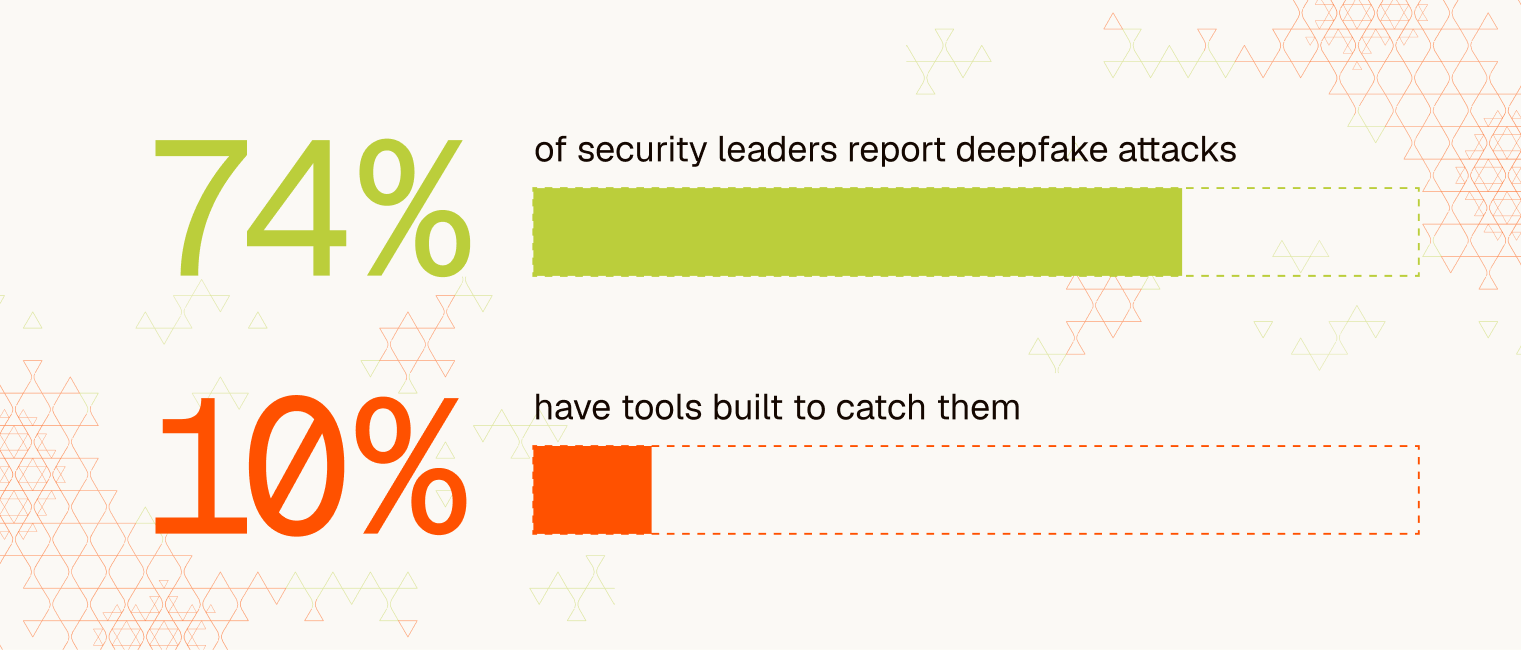
Most companies have already adopted tools that model Zero Trust, embedding verification across their network and systems. Yet deepfakes evade those controls; they can pose a risk to every virtual business interaction: phone calls into your helpdesk, remote job interviews, and sensitive video meetings with executives. Until companies treat deepfakes like the serious enterprise threat they are, most will remain vulnerable.
Pindrop surveyed 250 U.S. security leaders at enterprise companies to find out exactly how unprepared companies are.
- 1 in 4 organizations impacted by a deepfake attack lost $1 million or more to a single incident.
- 93% of enterprise security leaders are concerned they aren't prepared for a deepfake attack.
- 74% of enterprise security leaders believe deepfake defenses will improve faster than attack quality.
- 3 in 4 enterprise security leaders say it will take a company leader being fooled or impersonated to make this a boardroom priority.
- 37% believe one successful attack could put a company like theirs out of business.
Keep reading to learn about:
- Enterprise Readiness: where your peers stand
- The Assessment: where you stand among them
- How Pindrop can help
Text
1%
Text
Text
1%
Text
Text
1%
Text
Text
Lorem ipsum dolor sit amet consectetur. Sit convallis ullamcorper et varius venenatis blandit vitae hendrerit blandit. Hac aenean tellus consectetur elit orci aenean ipsum arcu. Turpis a laoreet sit rhoncus eros penatibus facilisis dolor tempus. Vitae gravida fames nunc dui scelerisque porta nulla ut. Sit mi volutpat ipsum odio nulla sociis.
Lorem Ipsum is simply dummy
Vitae eleifend mi lorem iaculis malesuada sit adipiscing vel. Sit massa ut etiam eu.