
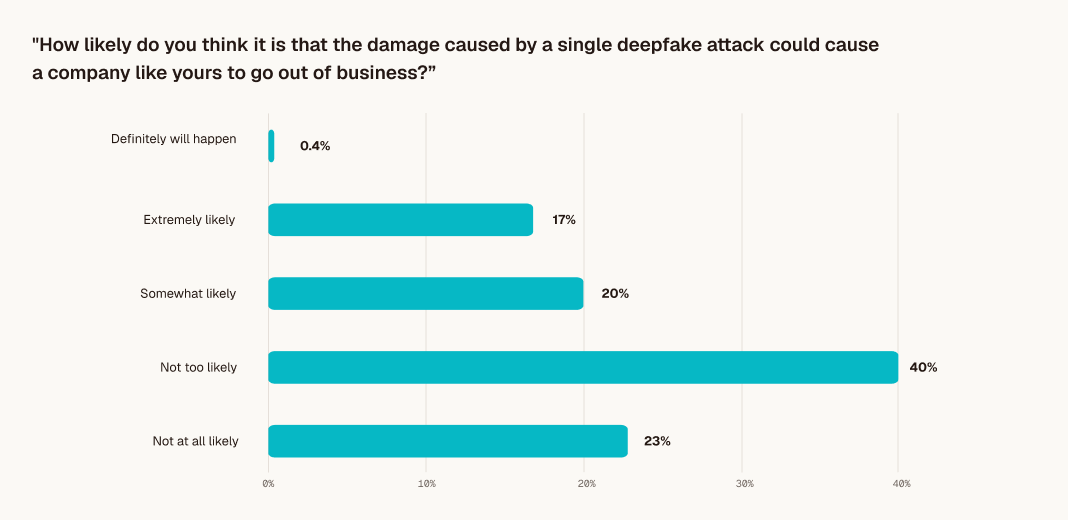
37% of security leaders consider it at least somewhat likely that a single deepfake attack could put a company like theirs out of business, including 17% who consider it extremely likely or certain.
PINDROP POV
These are the people inside organizations who have seen the attack surface up close, who understand what a successful synthetic identity attack means, and who are responsible for the defenses meant to stop it. When they describe a threat as potentially company-ending, it’s time to act urgently.Deepfakes are an identity attack that exploits how your organization verifies trust in human communication. This attack can touch every function in your business: finance authorizing a wire transfer, IT resetting credentials, an executive making a decision based on a voice they recognized. And the impact of a single successful attack isn't contained to one system or one team.
With 90% of security leaders without real-time detection tools and AI attacks growing 8x faster than traditional tactics, attempts are inevitable. But exposure is not.
Security leaders have solved complex security challenges before. Now organizations must enable risk detection at the exact moment their enterprise needs it.
Text
1%
Text
Text
1%
Text
Text
1%
Text
Text
Lorem ipsum dolor sit amet consectetur. Sit convallis ullamcorper et varius venenatis blandit vitae hendrerit blandit. Hac aenean tellus consectetur elit orci aenean ipsum arcu. Turpis a laoreet sit rhoncus eros penatibus facilisis dolor tempus. Vitae gravida fames nunc dui scelerisque porta nulla ut. Sit mi volutpat ipsum odio nulla sociis.
Lorem Ipsum is simply dummy
Vitae eleifend mi lorem iaculis malesuada sit adipiscing vel. Sit massa ut etiam eu.