
Weaponizing authority for deception
When an employee gets a suspicious email, security training tells them to verify through a different channel. But when they join a video call and see a face they recognize, that feels like verification. Even though it isn’t. In the AI era, seeing and hearing someone is no longer proof that they’re real, and most employees don’t know that yet.
Executive impersonation is happening now, and virtual meetings are one of the biggest blind spots enterprises have. A cloned voice or face in a meeting carries the same authority as the real thing, and in many cases, nobody in that room can tell the difference. A random text asking for gift cards is easy to dismiss, but a call that sounds and looks identical to your CEO? That’s much harder to ignore.
Real world example
According to a 2025 PSA from the FBI,1 bad actors have been impersonating government officials, including Cabinet members and members of Congress, to gain unauthorized access since 2023. These attackers send AI-generated voice messages and texts, posing as senior U.S. officials to build rapport with targets before manipulating them for their own gain.
In the summer of 2025, an AI-generated voice clone impersonating Secretary of State Marco Rubio successfully reached senior U.S. officials and foreign ministers.2 Just a synthetic voice lifelike enough to pass as a high-ranking government official.
These same tactics are already being used against corporations. Anyone in a position of authority or influence is an impersonation target. Fake CEOs releasing financial documents, making public announcements, manipulating an employee—all can lead to serious reputational, operational, and regulatory fallout.
Deepfake leaders can end in multi-million dollar mistakes
Think about what happens when an employee joins a meeting with their CEO who asks them to move fast on a wire transfer. The instinct is to help, to not slow things down, and to trust the person at the top. Executive impersonation works because it exploits something security training struggles to override: the instinct to comply with authority.
And the damage goes beyond manipulated employees. Fake videos of leaders making statements about financials or product updates can do serious damage to brand reputation too. Leaders have access, influence, and trust. AI lets scammers mimic all three.
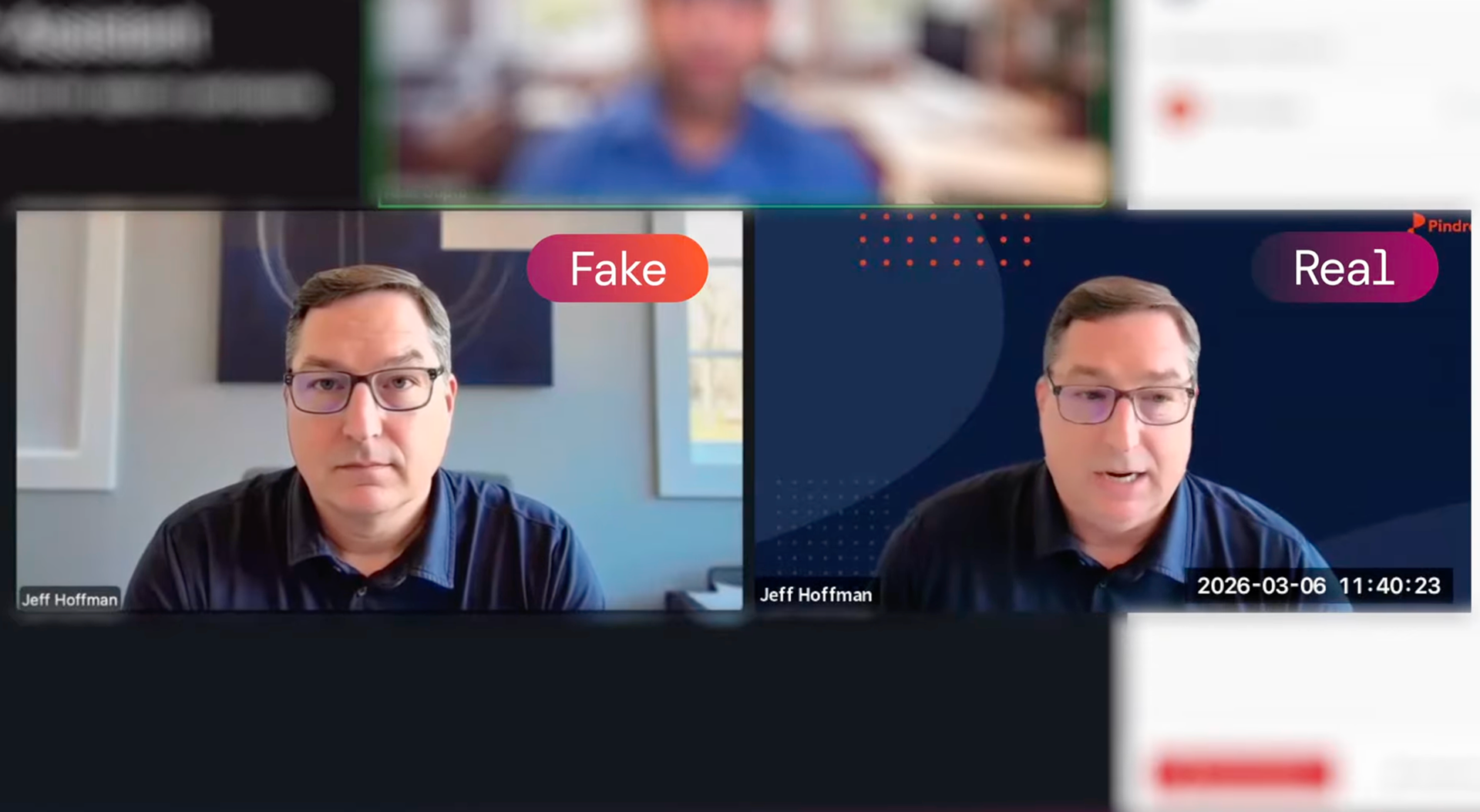
We created a deepfake of Pindrop’s CFO to prove just how easily attackers can join meetings as a fake executive.
Real stories and real damage of fake leaders

Real world example
Attackers impersonated WPP’s CEO using a fake WhatsApp account, cloned voice, and deepfake video to pressure an executive for money and sensitive information.3

Real world example
Scammers ran a highly realistic Elon Musk deepfake on YouTube to promote a crypto scam. It pulled in 140,000 viewers and stayed live for hours.4

Real world example
In May 2026, The Singapore Police Force released a statement about a scam involving a fake Zoom meeting impersonating Singapore’s Prime Minister and other senior government officials to solicit phony government funding. One victim wired S$4.9 million (US$3.8 million) before the scheme was uncovered.⁶

Real world example
Arup lost $25 million after an employee joined a video call with what looked and sounded like their CFO. It was a deepfake, and the transfer went through before anyone caught it.5
Text
1%
Text
Text
1%
Text
Text
1%
Text
Text
Lorem ipsum dolor sit amet consectetur. Sit convallis ullamcorper et varius venenatis blandit vitae hendrerit blandit. Hac aenean tellus consectetur elit orci aenean ipsum arcu. Turpis a laoreet sit rhoncus eros penatibus facilisis dolor tempus. Vitae gravida fames nunc dui scelerisque porta nulla ut. Sit mi volutpat ipsum odio nulla sociis.
Lorem Ipsum is simply dummy
Vitae eleifend mi lorem iaculis malesuada sit adipiscing vel. Sit massa ut etiam eu.