


In 2026, deepfakes are lurking in the virtual interactions that still rely on trust: contact centers, hiring processes, IT help desks, executive communications, and even remote work environments.
Pindrop’s 2026 Deepfake Readiness Index revealed a troubling gap between exposure and preparedness.
In fact, 74% of surveyed security leaders said their organizations had probably or definitely encountered a deepfake attack. However, only 10% had purpose-built tools to detect one, while 93% were concerned that their organizations were not prepared.
Security leaders understand that deepfakes are a serious threat, and many believe defensive technology can eventually keep pace. The larger challenge is making deepfake defense an urgent enterprise priority.
We can’t choose when we have to up our game and adjust the controls. The threat actors have chosen that. — Jim Routh, Chief Trust Officer @ Saviynt
AI is leading to high-volume, high-quality fraud
As of September 2026, Pindrop found that synthetic fraud alerts increased more than 23x, compared with the last three months of 2024. Traditional fraud increased approximately 2.3 times over the same period.
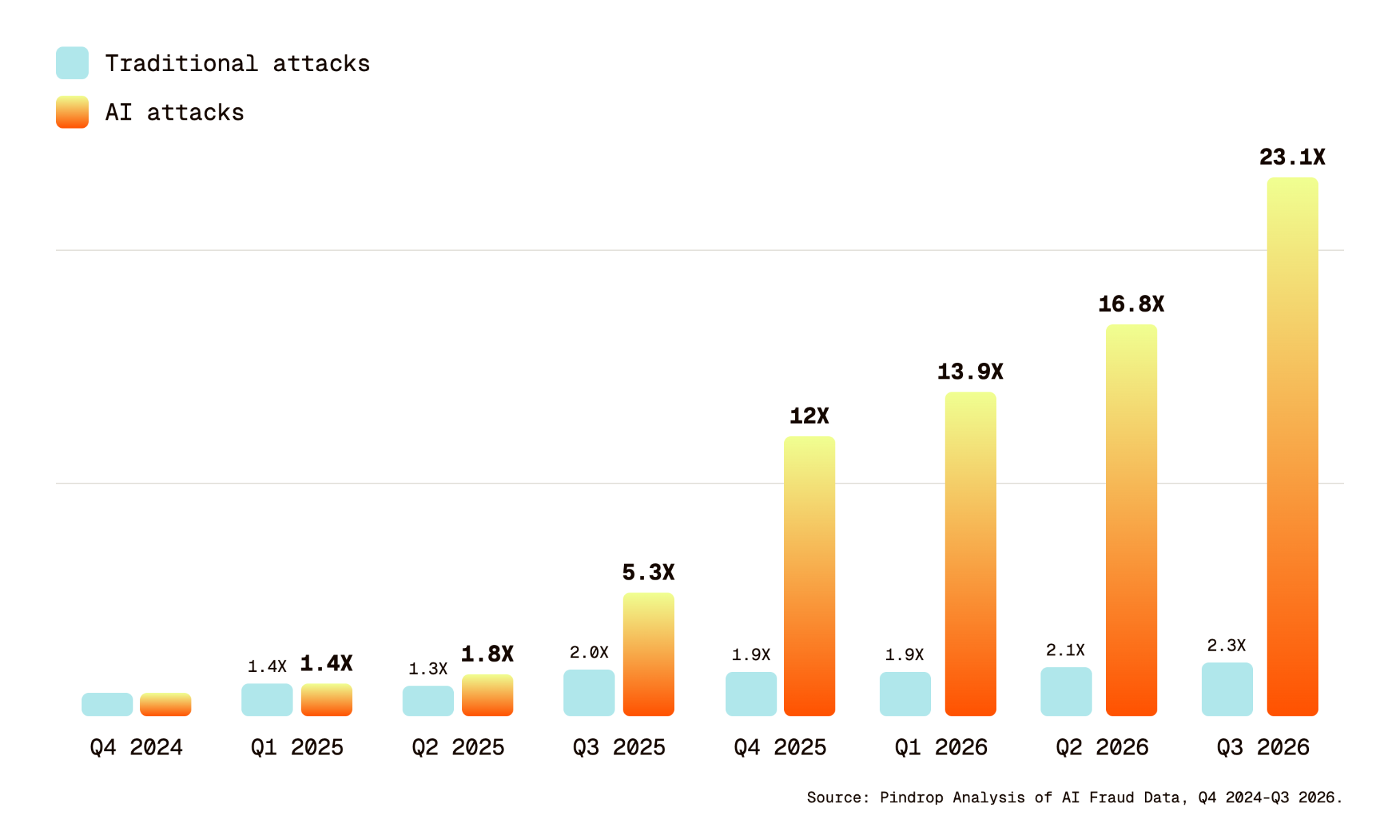
The sharp rise points to one clear trend: attackers are adept at using AI, and the sheer volume of attacks is only going to accelerate.
Deepfakes are an expensive problem to have, and its cost is more than financial
Among respondents in Pindrop’s research, we found that 49% experienced follow-on attacks like ransomware, 43% experienced compliance risk, and 41% suffered a data breach.
25% of the respondents that experienced an attack reported losses of at least $1 million. Worse, one in three respondents believed a single deepfake attack could put their company out of business.
An attack may begin with a single phone call or video interaction, but its consequences can spread throughout the organization.
Attackers are honing in on contact center representatives
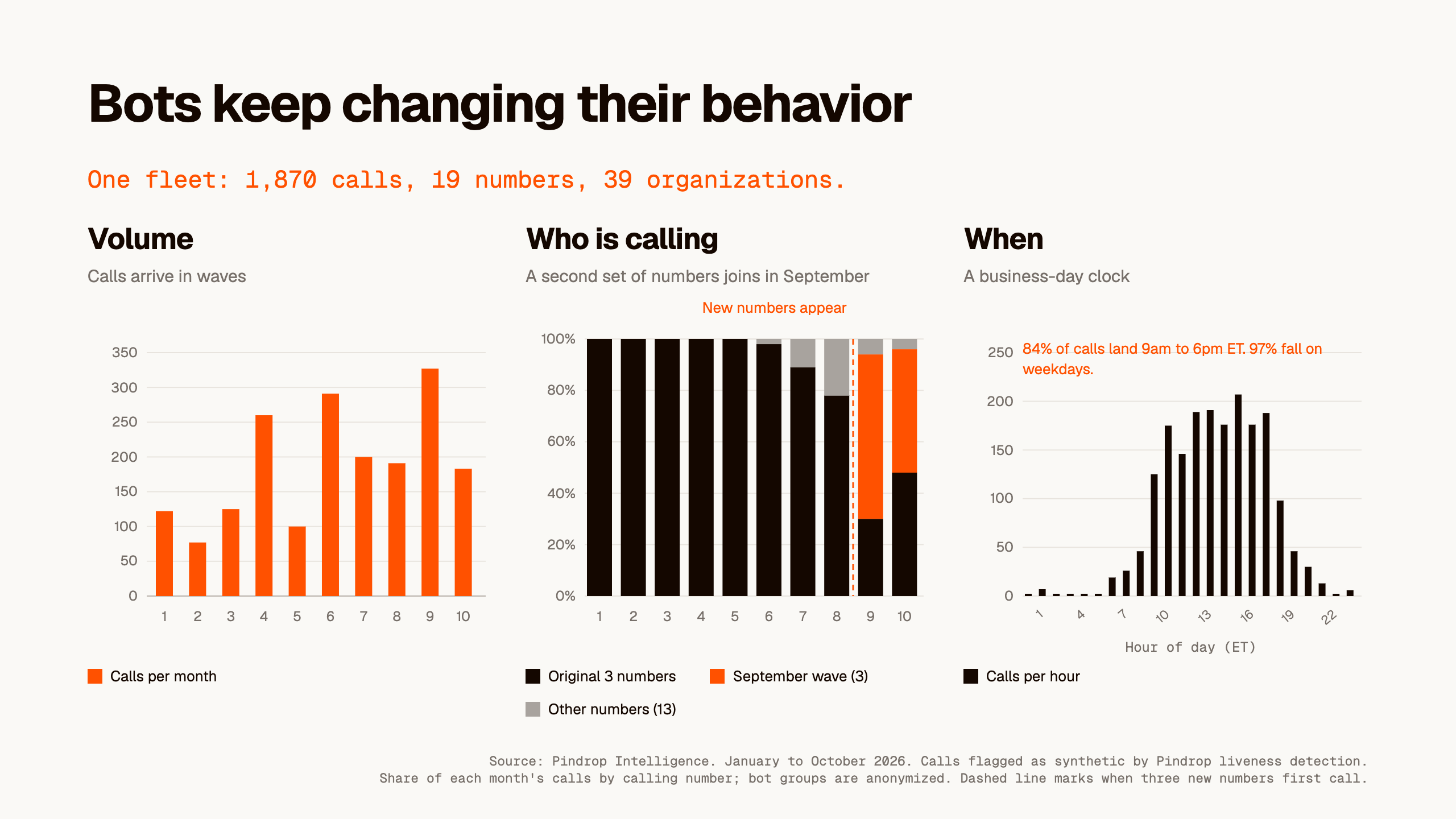
AI bots are increasingly being used against contact centers. At Pindrop, we saw a bot make repeated calls over an extended period.
Its activity changed from month to month, but its behavior consistently adapted: it changed phone numbers, adjusted its volume, and called during business hours.
Rather than simply trying to flood the contact center with calls, the bot was trying to avoid detection long enough to reach a human representative.
Sometimes, attackers want to reach a person who can be persuaded to provide information, reset a credential, change an account, or authorize an action.
The potential impact of these attacks may only be limited by the attacker’s ability to remain undetected.
Deepfakes are creating risks across the entire enterprise
Deepfake attacks appear wherever organizations use voices, faces, or familiar interactions to establish identity.
Deepfakes are making executive impersonation more convincing, too. A scam that once arrived as a text message from a fake executive can now take place in a video meeting.
An attacker may appear and sound like a real leader while requesting money, sensitive information, or an urgent business action.
Hiring is an overlooked attack surface
Deepfake job candidates present another growing risk. The goal of hiring fraud campaigns may extend beyond gaining employment because they can generate income, access systems, create insider opportunities, or even help fund broader cyber-espionage operations.
The more dependent we are on human interaction, the more this particular technology becomes a challenge, because you can no longer trust the human interaction. — Jim Routh, Chief Trust Officer @ Saviynt
The same playbook can be reversed. In the Binance crypto hack, a real employee interacted with a fake recruiter and downloaded a take-home assessment onto a work computer.
The computer was compromised, an internal AI tool was abused, and cryptocurrency wallets were drained.
You can’t wait for attackers to slow down to take action
Security teams must consider customers, operations, compliance, resilience, and business continuity before deploying new technology.
Threat actors do not face the same limitations. They can experiment aggressively and adopt new tools as soon as they become available, creating an imbalance.
Every new technology can improve business operations and customer experiences. At the same time, it can expand an organization’s attack surface.
You have to continuously validate and revalidate that the person interacting with us is not only a person, but the right person. — Jim Routh, Chief Trust Officer @ Saviynt
As AI capabilities evolve, security teams can’t wait for the next annual planning cycle to adjust their controls. Attackers are already changing tactics, and organizations must adapt alongside them.
Go from one-time authentication to continuous verification
Traditional identity and access management is often built around a single act of authentication: a user either has the correct credentials or does not.
Deepfakes challenge that by making it possible to imitate the signals people have traditionally used to establish identity: a voice, a face, a video presence, or a familiar interaction.
Organizations should not verify identity only once at the beginning of a high-risk interaction. They should continuously evaluate whether the person is real, whether they are the right person, and whether their behavior remains consistent with the situation.
This is especially important in remote work environments, where organizations increasingly depend on video meetings, digital collaboration, and real-time communication. Human judgment can remain part of the process, but it can no longer be the only line of defense.
8 deepfake detection to-do’s for your own organization
A general-purpose deepfake detector may not work equally well in every environment because calls, video meetings, and other channels have different technical characteristics.
Telephony audio, for example, is often compressed and limited in bandwidth. Video meetings introduce their own artifacts and challenges. Detection tools must be designed for the channel in which they operate.
Organizations should evaluate whether their systems can detect synthetic voice and video under real-world conditions—not only in ideal testing environments. Organizations can begin by:
- Identifying the highest-risk communication channels and business functions
- Evaluating exposure across contact centers, hiring, executive communications, IT support, and remote work
- Adding continuous identity verification to high-consequence interactions
- Using detection tools designed for specific channels
- Establishing procedures for escalating suspicious voice and video interactions
- Monitoring cloning technologies and updating controls as attack methods evolve
- Connecting fraud-reduction opportunities to investments in defensive capabilities
- Benchmarking organizational readiness against peers and industry expectations
Organizations must verify identity before releasing money, information, credentials, or access. Deepfakes have changed the rules of enterprise security. The organizations that respond successfully will be those that recognize this shift early and move from one-time, trust-based authentication to continuous, technology-supported verification.
Take the deepfake readiness assessment to see where you stand.
Key results
1%
Text
1%
Text
1%
Text
Lorem ipsum dolor sit amet consectetur. Sit convallis ullamcorper et varius venenatis blandit vitae hendrerit blandit. Hac aenean tellus consectetur elit orci aenean ipsum arcu. Turpis a laoreet sit rhoncus eros penatibus facilisis dolor tempus. Vitae gravida fames nunc dui scelerisque porta nulla ut. Sit mi volutpat ipsum odio nulla sociis.
Lorem Ipsum is simply dummy
Vitae eleifend mi lorem iaculis malesuada sit adipiscing vel. Sit massa ut etiam eu.