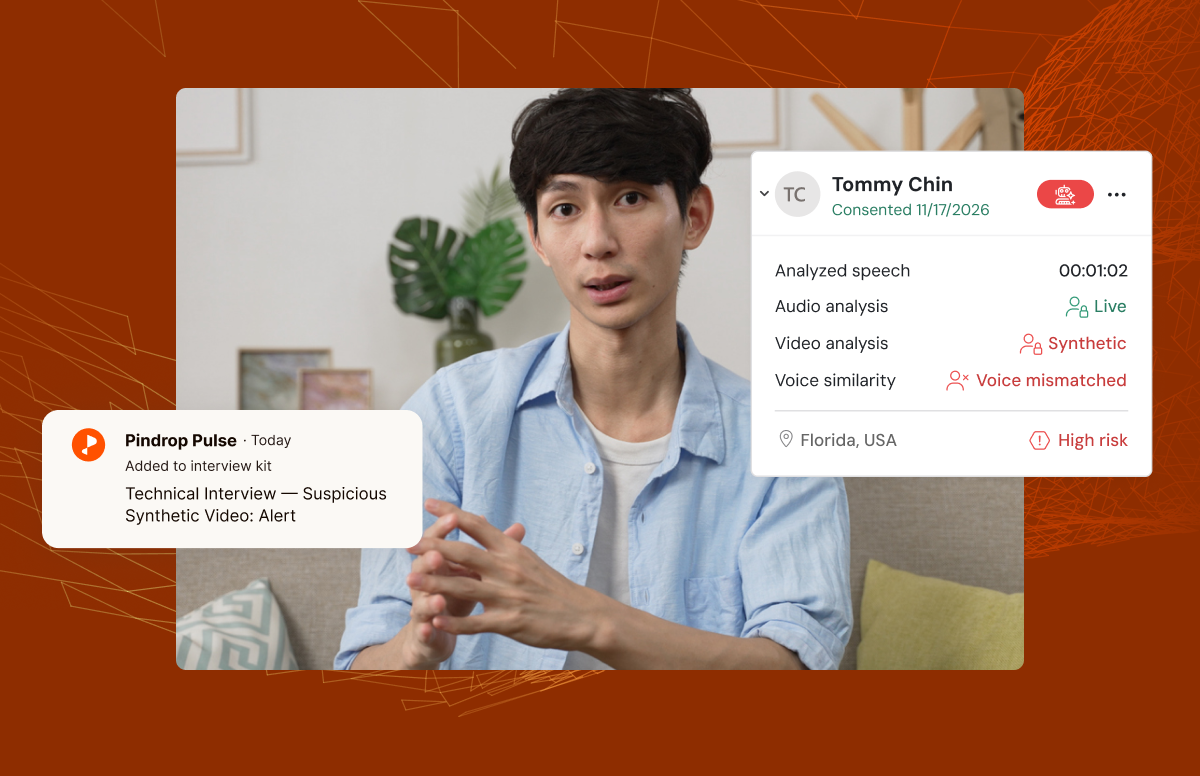


In Pindrop's® 2026 Deepfake Readiness Index survey of 250 enterprise security leaders, 74% said they had probably or definitely encountered a deepfake attack, yet only 10% had purpose-built tools to detect one.1
At the same time, 93% said they were concerned that their organization was not prepared.
The challenge is becoming more urgent as AI-powered fraud grows.
Pindrop found that synthetic fraud alerts increased 23x compared with the fourth quarter of 2024, while traditional fraud increased by roughly 2.3 times over the same period.1
Voice-cloning systems can now produce convincing speech with different accents, background noise, and simulated contact-center environments.
But there’s a new kid on the voice block: AI voice bots, like Meta’s Muse and Block’s Dessa, that are already raising questions about the contact center and security workflows we've relied on for decades.
The mass adoption of routine call automation is on its way, as are deepfakes. Here’s what to know when managing voice bots and deepfakes in your own organization.
What is a voice bot?
Sometimes used interchangeably, AI voice bots and deepfakes describe different capabilities.
A voice bot (also called an AI voice agent) is designed to have a conversation with a human. They ask questions, respond, navigate IVR phone menus, gather information, and even complete transactions.
Its defining capability is automation: it can interact with a person or a system at scale. Examples of voice bots today include:
A deepfake voice, by contrast, uses AI-generated or manipulated speech to specifically impersonate a real person or create the impression of an authentic human speaker.
Voice bots and deepfakes can both be fraudulent, but are different technologies
While these seem similar upon the surface, think about it this way:
- A voice bot is meant to sound human enough to hold a conversation. They likely have multiple voices, like Muse’s Hailey or Brett, which are recognizable across organizations.
- A deepfake is meant to sound like a specific human, and can be used for impersonation, including fraudulent acts (e.g., gaining account access).
These capabilities can be used together or separately. A
n attacker might use a generic synthetic voice to navigate a phone system and gather information, or they might pair a conversational AI agent with a cloned customer’s voice to impersonate that person during a call.
That specific attack is not a “deepfake of a voice bot,” it’s an automated agent using a deepfake voice. The voice bot provides the ability to converse; the deepfake provides the ability to impersonate.
Voice agents and deepfakes present different challenges for contact centers, particularly when they're used for fraud:
- A bot can pretend to be a human customer without copying that customer’s voice. It may rely on stolen account details, scripted responses, and a convincing conversational style to reach a live representative or complete an automated process.
- A bot can pretend to be a particular customer by combining automated conversation with a deepfake version of that customer’s voice. The cloned voice adds an impersonation layer to the broader automated attack.
The outcome of both scenarios depend on the organization’s verification and authentication controls, the sensitivity of the action, and whether the attacker can remain undetected long enough to reach a useful decision point.
Updating a password or address is much higher risk than checking a balance.
It’s also important to note that not every AI-generated voice is fraud. Pindrop’s research team found that out of 1.88 million AI agent interactions. 94% were good agents, and 6% were considered malicious.2
People use AI assistants to call businesses and check wait times, and so detecting a synthetic voice doesn’t establish intent by itself.
Why contact centers are especially exposed
Contact centers use conversation as part of the identity-verification process, and attackers can exploit that dependence in several ways:
- Impersonating customers
- Attempting to change account information
- Requesting credential resets
- Gathering information
- Persuading representatives to authorize an action
Traditional signs of fraud, like phone numbers and basic behavioral patterns, are becoming less reliable. Attackers can rotate numbers, adjust their behavior, and use realistic synthetic voices to target controls designed for an earlier threat environment.
The goal is not always to generate the highest possible volume. Instead, they’re trying to avoid detection long enough to reach a real representative who can provide information or make a consequential change.
Trust can no longer be the final control
Voice bots and deepfakes are connected, but they’re not identical. Voice bots automate interaction. Deepfakes imitate identity.
When combined, they can make fraud more scalable, more persuasive, and harder to detect.
Pindrop BotStopperTM technology detects AI-generated voices on incoming calls, helping contact centers distinguish AI callers from humans and make more informed decisions about how to handle those interactions. Get a demo to learn more.
Key results
1%
Text
1%
Text
1%
Text
Lorem ipsum dolor sit amet consectetur. Sit convallis ullamcorper et varius venenatis blandit vitae hendrerit blandit. Hac aenean tellus consectetur elit orci aenean ipsum arcu. Turpis a laoreet sit rhoncus eros penatibus facilisis dolor tempus. Vitae gravida fames nunc dui scelerisque porta nulla ut. Sit mi volutpat ipsum odio nulla sociis.
Lorem Ipsum is simply dummy
Vitae eleifend mi lorem iaculis malesuada sit adipiscing vel. Sit massa ut etiam eu.