

Questions like these are swirling through organizations of all shapes and sizes across many industries. Here’s a guide to the AI agents now calling, what they want, the risks, and what you can do about them.
First, what is an AI agent?
Think of an AI agent as an assistant that can actually do things, not just answer questions. You tell it, “schedule a dentist appointment,” and it picks up the phone, talks to the front desk, waits on hold, and reports back.
I’ve listened to many synthetic voice samples and am amazed at how far the technology has come in just the last 18 months. Just listen to these examples:
Summer 2025:
Early 2026:
And the voices are only getting better. Block recently previewed Dessa, a research voice model (not yet broadly available) that talks and listens at the same time, so it handles interruptions, pauses, and even laughter. Even to a trained human ear, it is difficult to tell what’s real and what isn’t. If you haven’t already heard their public samples, it’s worth checking out on their website.
As AI agents proliferate, “Does it sound human?” is simply not a useful test anymore. Some companies even tell their staff not to ask callers whether they’re AI, so the call recipient may never find out.
Good, nuisance, or bad? It depends on the job
As your team figures out what to do with AI agent callers, it’s helpful to start to sort them according to what they’re trying to do. Consider these three categories:
- Good agents act legitimately (from the “owner’s” perspective) on behalf of a consumer or institution. Think of a customer’s assistant rescheduling an appointment, or a provider office’s agent checking on a claim.
- Nuisance agents are robocalls and high-volume automated traffic. They’re probably not after anything sneaky, but they eat up queue time and agent capacity.
- Bad agents map the IVR ahead of a takeover and impersonate customers, patients, or organizations. They probe for authentication gates, collect account details (including PII and PHI), and set up fraud.
Across industries, agents have different objectives, and some objectives carry high risk while others do not.
How these AI agents show up across banking, healthcare, and retail
Here’s where things get interesting. Notice the overlap between good agent and bad agent objectives. A request for an account balance could be legitimate, or it could be the beginnings of a fraud scheme. One agent is collecting helpful information for its operator; another is a bot casing the place.
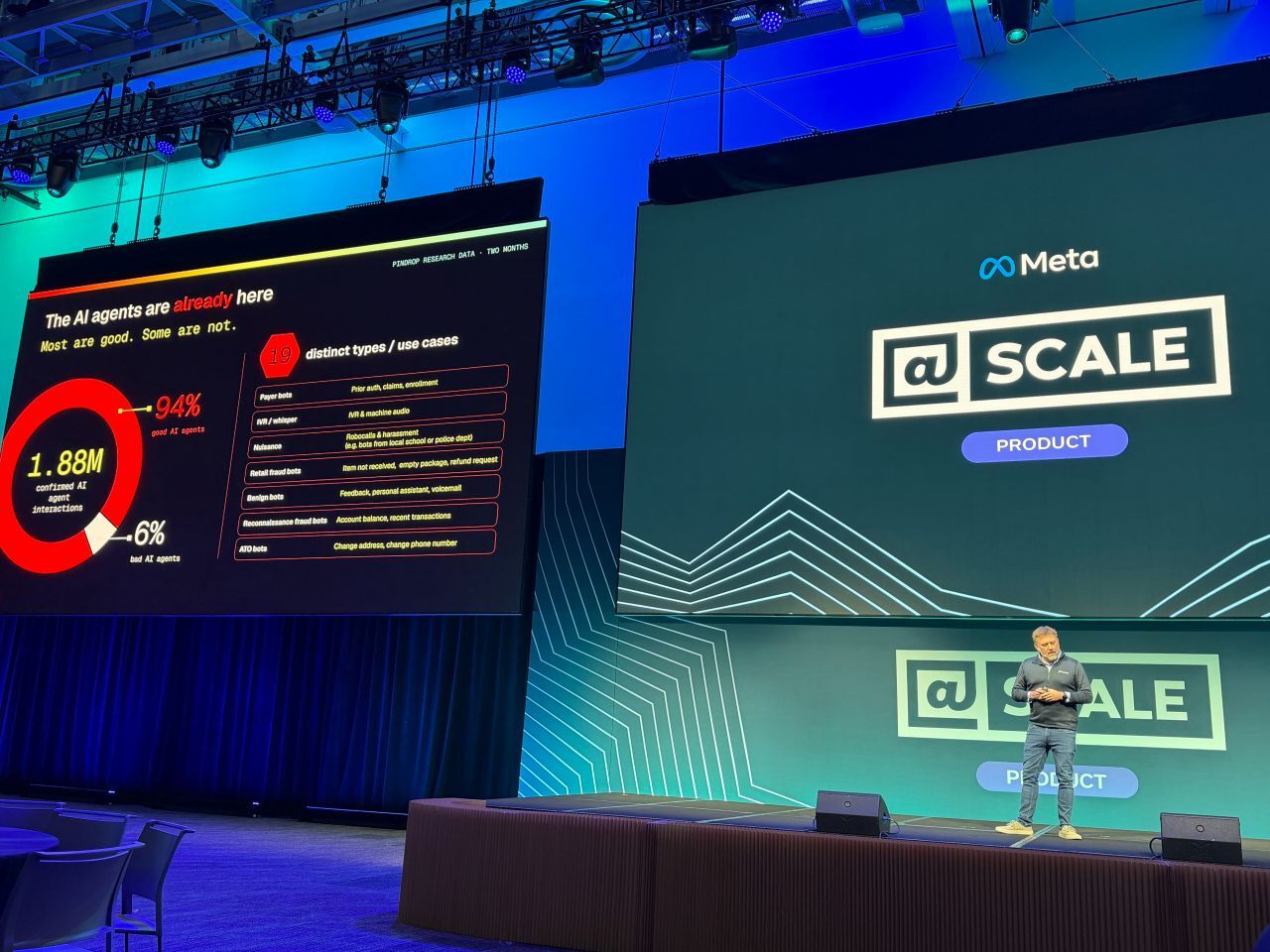
Our data shows that 94% of agent callers are legitimate, but 6% are malicious. Across millions of calls, 6% adds up quickly and represents meaningful risk for seemingly “safe” requests. Let’s consider the implications of trusting (or not trusting) agent callers, but first, let’s review some of the agents out there.
Meet the voice agents making calls
Several of the big brands out there offer agentic technology to consumers and organizations today. As with most tools, any of them could be pointed at a good task, a nuisance task, or a bad one.
Pindrop® saw Muse’s weekly call volume grow 8x among our customer base in just a few weeks.
Why “mostly legitimate” is the problem
If every agent were a threat, managing them would be easy: block them all and call it a day. If none were a threat, you could ignore the whole thing and service all of them. Instead, you’re stuck in the messy middle.
Good and bad agents often look (and sound) alike. Reconnaissance calls often seem harmless because nothing goes wrong right away. This is particularly true when the request at hand seems innocent enough – checking a balance, order status, claim status, etc.
Refusing everything has a cost. If organizations turn away every agent, this is the “safest” move, but it perpetuates other friction points. In healthcare, if payers turn away every agent, providers go back to the manual and frustrating phone calls (like checking patient benefits and managing prior authorizations) that drove them to use an agent in the first place. If banks turn away every customer agent, they, in effect, punish the customers who use one.
As assistants become more mainstream, inconsistent acceptance across organizations creates frustration. Someone who asked their assistant to handle a routine request hears “no” from you and “yes” from a competitor. And tougher authentication meant to keep agents out can trip up human customers too, who end up as unintended damage.
Accepting everything has a cost, too. Checking a balance and requesting a funds transfer carry very different risk. Organizations have to ask if they are willing to allow agents to do anything a human could do, which would please a lot of agent operators, good and bad.
Where things stand: early, and moving fast
People are naturally curious, but also not ready to hand over their lives to AI Agents, at least not entirely. In an Accenture survey of more than 25,000 consumers, 74% would hand routine tasks like negotiating deals and resolving complaints to an AI agent. Only 9% were open to one making purchases on its own.
Industry standards are still forming, too. Meta, Walmart, Stripe, and others announced the Personal Agent Protocol in October, which aims to standardize how AI agents and businesses can work together. OpenAI and Anthropic have not yet signaled they will participate.
In short, it’s early, but as the rapid changes in AI demonstrate, the ice will melt quickly and it’s better to be prepared.
What can you do about it in your contact center?
Start with the one question everything else depends on. Is this caller a human or a machine?
From there, determine what the agent caller can do vs a human caller can do. Again, different tasks carry different risks (transferring funds vs scheduling a dinner reservation). If an AI agent calls, what tasks will you allow it to perform?
Technology, like Pindrop BotStopper™, helps detect what humans fail to do consistently. By identifying AI callers early in the call, teams know a machine is on the line and can act accordingly.
Recognizing an AI voice doesn’t prove a customer authorized it, but it does provide a critical signal. Your policy decides what happens next.
Telling humans from machines is the first step, but not the finish line. The next steps are harder, and the industry is still working on them. Organizations will need to identify and authenticate the agents themselves: which agent is calling, who it works for, and whether it is actually authorized by its owner to do what it asks. That is how they will know an agent is legitimate and trust it accordingly.
To help you evaluate and plan how your organization will handle inbound AI callers, consider these three actions:
- Measure. Find out how much of your inbound volume is automated and what those callers want.
- Set policy by risk. Send read-only requests, like balance checks and claim status, to automated channels; but even here, be careful, as these details may also be connected to PII or PHI. Require extra verification for account changes, payout updates, and transfers.
- Plan to authenticate agents. Organizations should prepare now to accommodate legitimate agent-powered interactions. We are in a transitional period while society and technology establish standards for verifying agent identities. By planning ahead for agent authentication, organizations can avoid being caught off guard as automated callers become mainstream.
Know what’s calling your contact center. Decide what happens next.
See Pindrop BotStopper™ tech in action, or ask us for a bot traffic baseline if you’re curious which agents are already calling.
Key results
1%
Text
1%
Text
1%
Text
Lorem ipsum dolor sit amet consectetur. Sit convallis ullamcorper et varius venenatis blandit vitae hendrerit blandit. Hac aenean tellus consectetur elit orci aenean ipsum arcu. Turpis a laoreet sit rhoncus eros penatibus facilisis dolor tempus. Vitae gravida fames nunc dui scelerisque porta nulla ut. Sit mi volutpat ipsum odio nulla sociis.
Lorem Ipsum is simply dummy
Vitae eleifend mi lorem iaculis malesuada sit adipiscing vel. Sit massa ut etiam eu.