

Companies are dealing with an entirely new population of callers: NVIDIA founder Jensen Huang predicted a 100-to-1 agent-to-employee ratio inside companies.1 Compare that against the UN's population projection for 2035 2, and we’ll see nearly a trillion AI agents.
These agents are an entirely new group of actors using the same businesses, systems, and data as people. A lot of people have plans when it comes to digital identity, but right now, there are no plans around managing bots in the real world. Voice is really that first foray into the real world.
Our own data points the way. From 2024 through 2026, we’ve seen AI-driven attacks grow roughly eight times faster than traditional attacks.
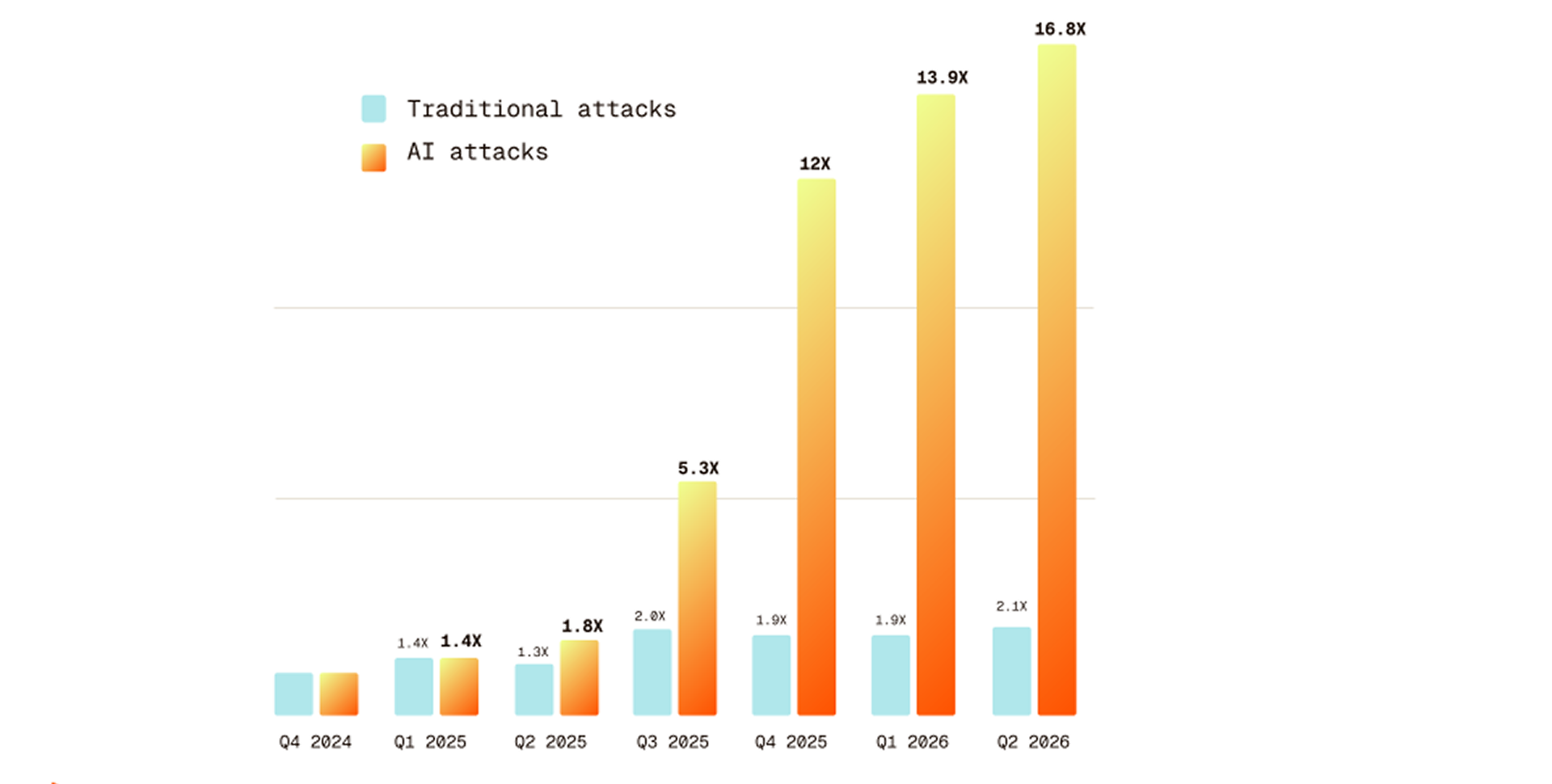
Hyper-realistic deepfakes, automation, and adaptive social engineering all favor the attacker. They can run more attempts, at lower cost, and adapt mid-conversation.
94% legitimate. 6% malicious. Both matter.
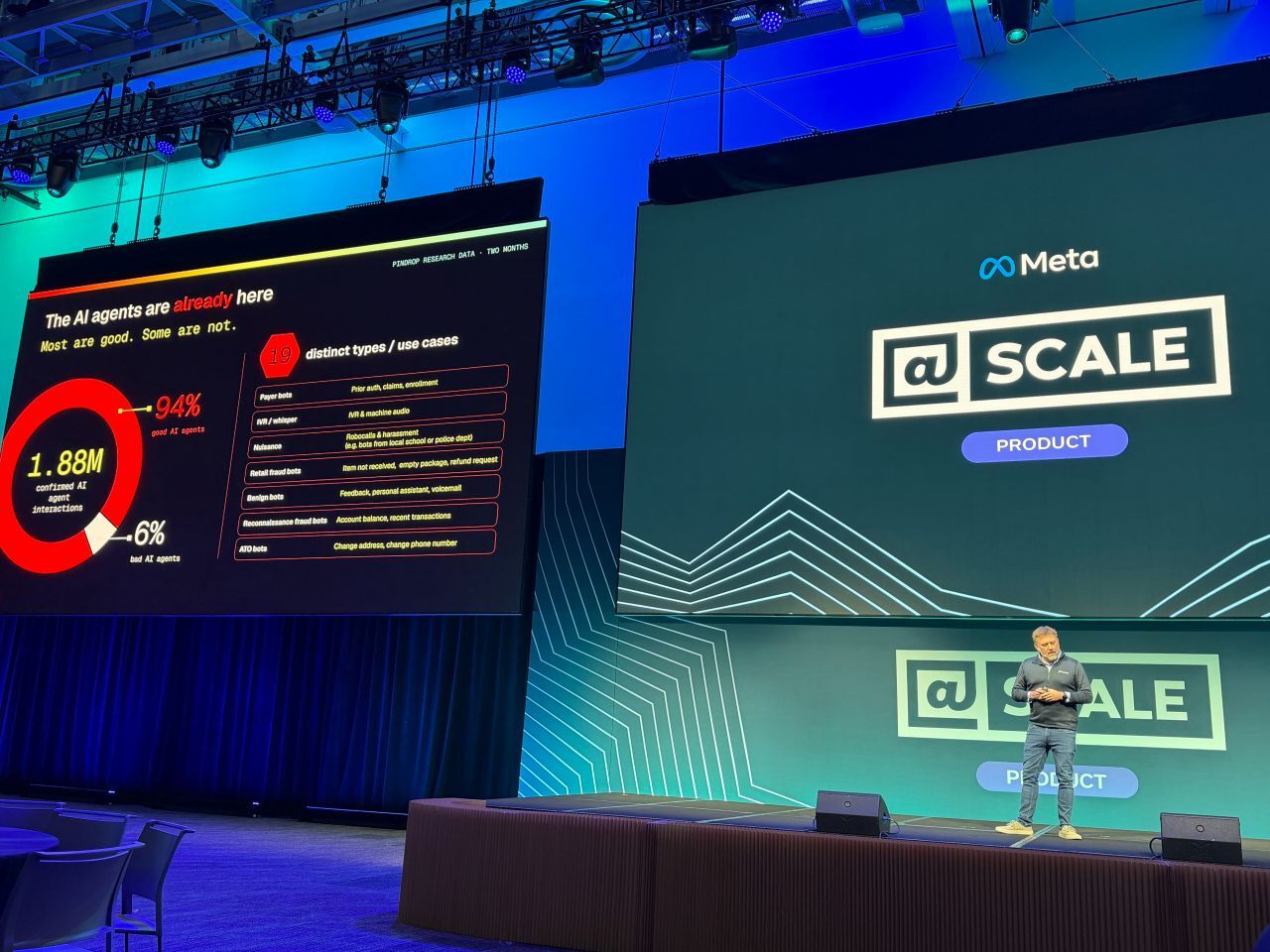
We wanted to know what this looks like on real calls, so we looked at three months of traffic across our customers.
We confirmed 1.88 million AI agent interactions. 94% were good agents, and 6% were bad. We found 19 distinct types and use cases, including:
Many of these are routine, like payer bots handling prior authorizations, claims, and enrollment. Others are not. We saw nuisance robocalls and retail refund scams, reconnaissance bots requesting account balances and recent transaction history, and even account takeover attempts that change an address.
While 6% seems small, that’s still more than 113,000 bad interactions, making a blanket ban on bots ineffective. Refusing every agent also turns away the ones helping real customers, and letting all of them through leaves the door open to the rest. To fix this, companies must understand which is which.
To detect bad bots, go big picture
Bad agents are extremely patient. They don’t sleep, get tired, and they have a lot of patience.
We saw a single bot place 1,870 calls to 39 financial institutions, healthcare organizations, and retailers in 100 days. The pattern suggests its operator tuned the bot, performing reconnaissance before setting it loose.
Pindrop research saw a single bot place 1,870 calls to 39 financial institutions, healthcare organizations, and retailers in 100 days. The pattern suggests its operator tuned the bot, performing reconnaissance before setting it loose.
A single call tells you little. You need to look at the big picture, understand the broader pattern, and make decisions on bot management from there.
How we look at a call
Because no single clue gives away a machine, we look at several. Pindrop rests on three engines, each answering one trust question:
- Is an identity synthetic? Pindrop Pulse® technology answers this by looking for machine-generated voices, including AI agents and deepfakes.
- Is an identity risky? Pindrop® Protect goes beyond fraud to flag abuse, social engineering, and policy violations.
- Is it known? Pindrop® Passport moves from one-time authentication toward continuous verification.
Behind those questions, we analyze calls across five signal layers:
- Network: phone number, carrier, line type (VoIP, landline, or mobile), and location.
- Device: microphone, phone or laptop, manufacturer, operating system, codec, and spoofing services.
- Behavior: dual-tone multi-frequency (DTMF) keypad patterns and anomalies, plus bot identification.
- Liveness: whether a real person is speaking, with checks for deepfake, playback, synthetic, and modulated audio.
- Voice: pitch, tone, speed, accent, timbre, and articulation.
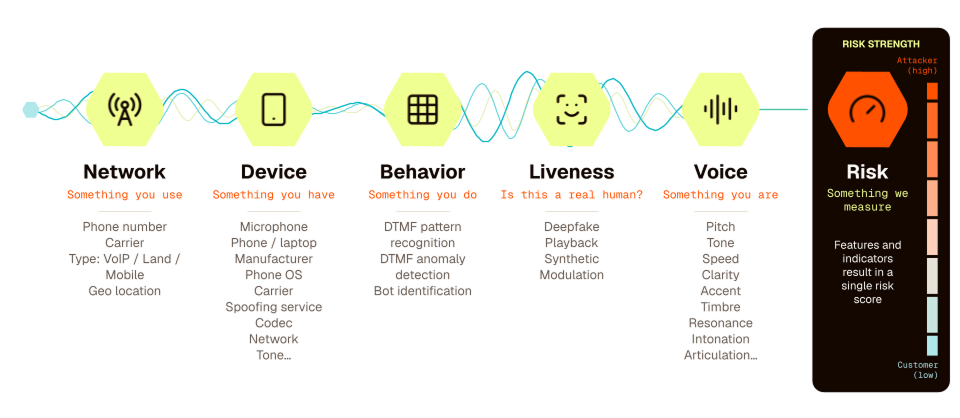
Those signals roll up into a single risk score, from likely customer to likely attacker.
Let the right bots in, and keep the malicious ones out
The knee-jerk reaction is to turn every bot away, but I don’t believe that’s the goal. Instead, we need to restore trust in these channels and build the trust layer that lets the right agents through.
Verification needs to be continuous and always-on, for people and agents.
Pindrop BotStopper™ technology detects AI agents and automated callers early in the call, so teams can start with the first question: is this caller a machine? To learn more about detecting and managing agents at your organization, talk to a human.
Key results
1%
Text
1%
Text
1%
Text
Lorem ipsum dolor sit amet consectetur. Sit convallis ullamcorper et varius venenatis blandit vitae hendrerit blandit. Hac aenean tellus consectetur elit orci aenean ipsum arcu. Turpis a laoreet sit rhoncus eros penatibus facilisis dolor tempus. Vitae gravida fames nunc dui scelerisque porta nulla ut. Sit mi volutpat ipsum odio nulla sociis.
Lorem Ipsum is simply dummy
Vitae eleifend mi lorem iaculis malesuada sit adipiscing vel. Sit massa ut etiam eu.