Pindrop Pulse® for meetings

Your video meetings aren’t safe anymore.

Frame-1073714970
PFM with logos and TIME award-updated June 2027 (1)

Pindrop Pulse® is a TIME Best Invention of 2025.

How Pindrop Pulse® for Meetings works

PFM – security assistant

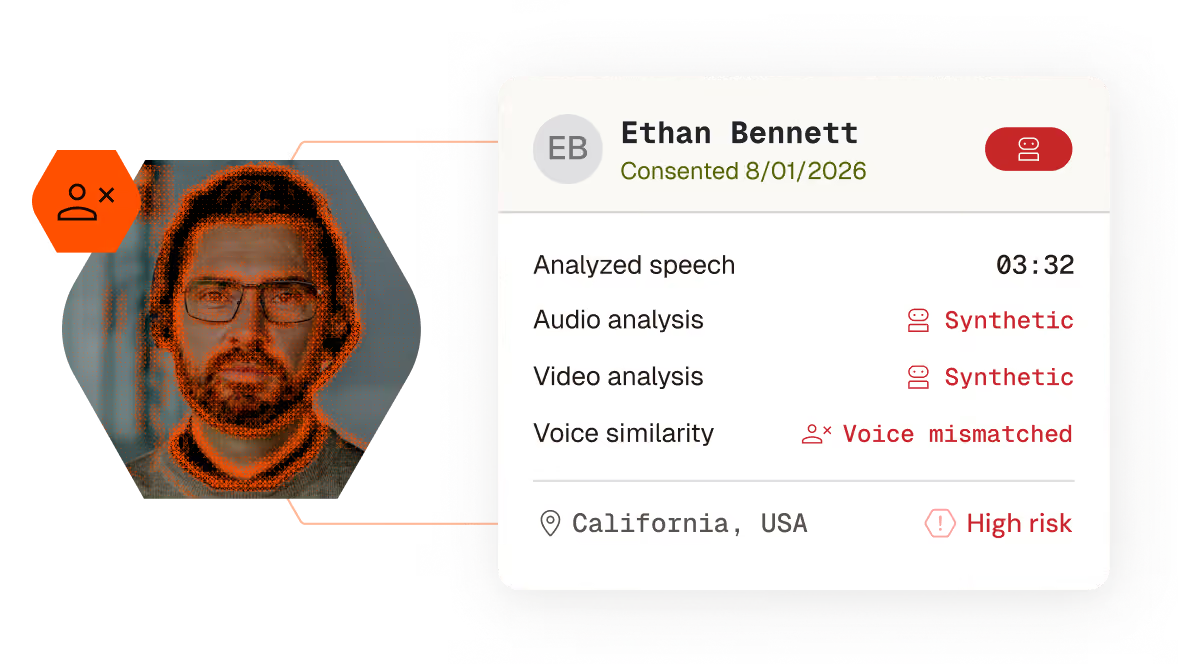
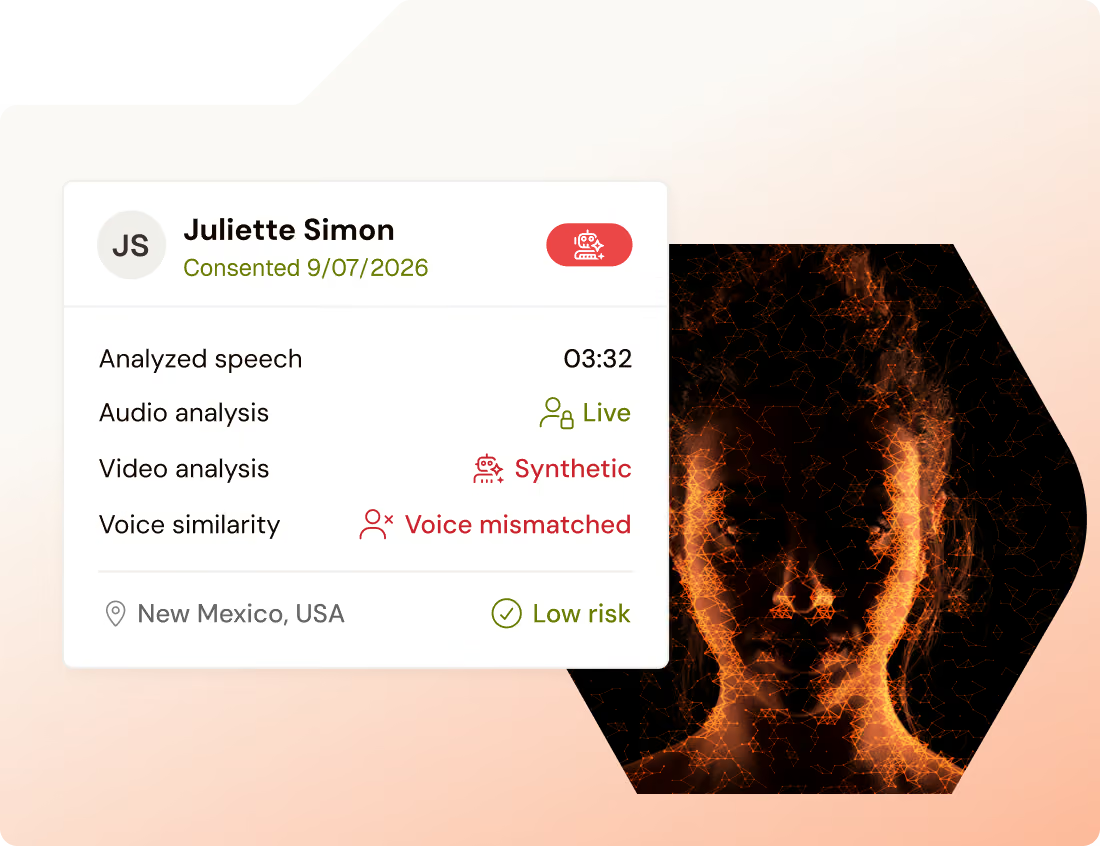
Audio and video deepfake detection

Analyzes audio and video in real time for signs of synthetic manipulation with 99% accuracy in audio deepfake detection7 and less than 1% false positives.8 Flags to the meeting host when an alert is detected.

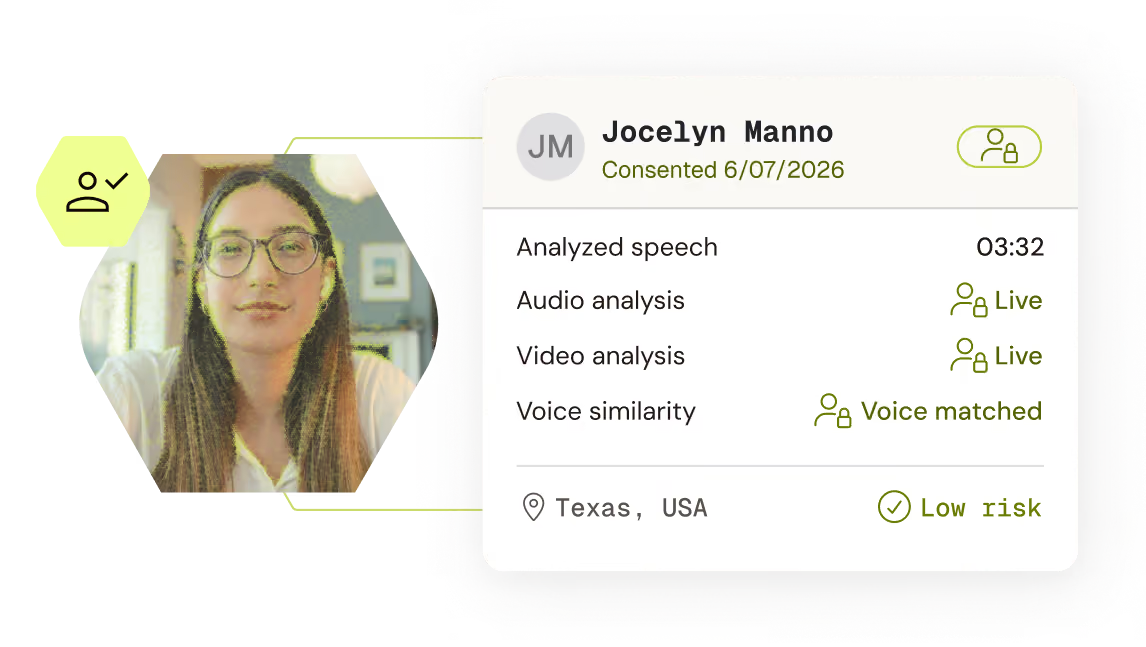
Pulse for Meetings – voice matched

Voice authentication

Leverages Pindrop Deep Voice® engine to confirm meeting participants are the right person.

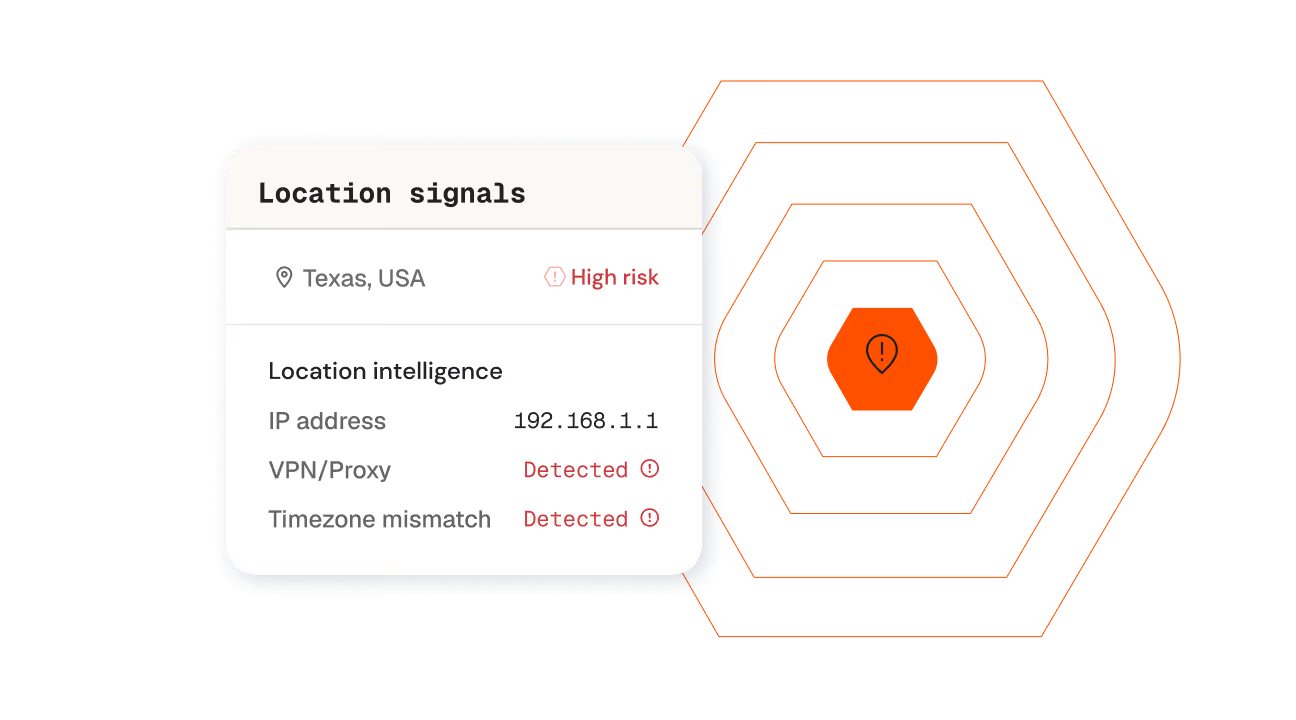
Pulse for Meetings – location analysis

Location risk signals

Surfaces risk indicators such as VPN usage or unexpected geographies.

Real human. Right human. Right location.

PFM Deepfake Job Candidates Demo Thumbnail

Deepfakes are getting smarter. Is your business prepared?  

Catch up on where deepfake and AI-enabled attacks are already impacting businesses, why traditional verification methods are falling short, and what you can implement to mitigate these evolving risks.

Pindrop Pulse® for Meetings FAQs

Pindrop Pulse® for Meetings is an enterprise meeting security solution that delivers deepfake detection through Continuous Identity Verification. Rather than verifying identity only when a participant joins a meeting, Pulse continuously evaluates identity signals throughout the conversation to help identify potential signs of AI-generated impersonation and other identity-related risks.

Pindrop Pulse® for Meetings continuously verifies the real human, right human, and right location. It evaluates identity signals—including passive voice authentication, audio and visual deepfake detection, and location integrity—to help security teams assess participant identity while working alongside leading enterprise collaboration platforms.

Virtual meetings have become an increasingly attractive target for identity-based fraud because they frequently involve sensitive business decisions without the ability to verify participants in person. Executive discussions, financial approvals, board meetings, remote hiring, customer interactions, and other business-critical communications now routinely occur online, expanding opportunities for AI-enabled impersonation.

Traditional meeting security primarily controls access to a meeting, but access alone does not continuously verify participant identity after a meeting begins. As enterprises adopt Zero Trust principles across users, devices, and applications, continuous identity verification extends those principles into live communications by evaluating identity throughout the meeting.

Pulse for Meetings is designed for enterprises that need robust identity verification during virtual meetings. It is particularly valuable for security teams, fraud leaders, IT administrators, compliance professionals, recruiters, executive assistants, and business leaders responsible for protecting sensitive conversations and business-critical decisions.

Common use cases include executive meetings, board discussions, virtual hiring interviews, customer onboarding, financial approvals, legal consultations, and other high-risk meetings where participant identity directly affects operational, financial, or regulatory outcomes.

Continuous identity verification is most valuable in meetings where participant identity influences business decisions, financial transactions, regulatory obligations, or access to sensitive information. A participant’s authenticity directly impacts strategic business decisions, financial authorizations, regulatory compliance, and the protection of confidential corporate data. Examples include executive leadership meetings, board meetings, mergers and acquisitions discussions, virtual hiring interviews, customer onboarding, legal consultations, healthcare appointments, and financial approvals.

Unlike traditional authentication, which typically verifies identity only once at sign-in, continuous identity verification evaluates identity signals throughout the meeting to help enterprises maintain confidence that participants remain who they claim to be.

Pindrop Pulse® for Meetings is designed to integrate with leading enterprise collaboration platforms, including Microsoft Teams, Zoom, and Cisco Webex. Enterprises can strengthen meeting security without replacing the collaboration tools employees, customers, and external participants already use.

By working alongside existing meeting platforms, Pulse adds continuous identity verification, passive voice authentication, deepfake detection, and location analysis to help security teams evaluate participant identity throughout virtual meetings. This enables enterprises to strengthen meeting integrity without requiring users to change how they schedule or participate in virtual meetings.

An AI meeting deepfake is the use of synthetic audio, video, or both to impersonate a legitimate participant during a live virtual meeting. Advances in generative AI have made it increasingly possible to imitate a person’s voice or appearance, making impersonation more difficult to detect through human judgment alone.

As identity-based attacks expand beyond email and text messages, virtual meetings represent a growing attack surface because participants increasingly rely on visual and verbal trust rather than in-person verification. Pindrop Pulse continuously evaluates identity signals to y detect video and audio deepfakes and other signs of AI manipulation throughout a meeting.

Pindrop Pulse® for Meetings continuously analyzes meeting audio and video for signs of AI-generated manipulation, including cloned voices, synthetic avatars, and face swaps. This helps security teams identify deepfake risk throughout a virtual meeting, not only when a participant first joins.

Pulse combines audio and video deepfake detection with passive voice authentication and location risk signals to help assess whether a participant is a real human, the right human, and joining from the right location.

Yes. Pindrop Pulse® for Meetings analyzes live meeting audio and video to detect signs of cloned voices and other AI-generated manipulation, including synthetic avatars and face swaps.

It also uses passive voice authentication and location risk signals to give security teams additional context when assessing participant identity during high-risk virtual meetings.

Pindrop Pulse® for Meetings helps identify AI-driven impersonation in live meetings, including cloned or synthetic voices, AI-generated avatars, and video face swaps. AI-enabled impersonation may involve synthetic speech, manipulated video, compromised accounts, or combinations of these techniques and other forms of digital deception to misrepresent a participant’s identity during a virtual meeting. These techniques may target executives approving financial transactions, recruiters interviewing candidates, customer-facing employees, or teams discussing confidential business information.

By continuously evaluating identity signals throughout the meeting, Pulse helps security teams recognize suspicious activity that may not be detected through traditional authentication alone.

According to Pindrop’s published performance results, Pulse achieves approximately a 1% false positive rate when detecting potential AI-generated impersonation. Pindrop also reports 99% detection of known deepfake engines and more than 90% detection of previously unseen voice cloning models.

These results are supported by independent third-party evaluations. In an NPR News evaluation of commercial audio deepfake detection solutions, Pindrop achieved the highest overall accuracy, correctly identifying 81 of 84 audio samples (96.4%). More recently, the independent Podonos Audio Deepfake Detection Benchmark ranked Pindrop as the fastest and most accurate commercial detector evaluated in its benchmark.

Pulse begins assessing participant identity using approximately 6 seconds of video and audio. Because identity-related risks can emerge at any point during a meeting, verification continues as additional evidence becomes available rather than ending after an initial assessment.

This continuous approach helps security teams identify potential identity risks while meetings are still in progress, enabling faster investigation and response when appropriate.

Continuous identity verification is an enterprise security approach that continuously evaluates whether participants remain who they claim to be throughout a live interaction. Unlike traditional authentication, which typically verifies identity only once, continuous identity verification reassesses identity as new evidence becomes available during a meeting.

As enterprises increasingly rely on virtual meetings for business-critical communications, identity-related risks can evolve after authentication. Pulse’s continuous identity verification system addresses this challenge by evaluating multiple identity signals—including passive voice authentication, deepfake detection, and location integrity—to strengthen identity confidence throughout a meeting.

Passive voice authentication is a form of voice-based identity verification that analyzes the unique characteristics of natural speech during conversation, rather than requiring an explicit authentication step. It verifies a person’s identity by analyzing the unique characteristics of their speech during normal conversation. Unlike traditional voice authentication, it does not require participants to repeat a passphrase or interrupt the meeting experience.

Voice characteristics represent one of several identity signals that can help continuously verify participant identity throughout a meeting. Pindrop Pulse incorporates passive voice authentication alongside deepfake detection and location integrity to provide a more comprehensive assessment of participant identity during live conversations.

Authentication answers “Who is accessing the meeting?”, while continuous identity verification reassesses participant identity throughout a virtual meeting. Logging in with valid credentials confirms access to an account, but it does not necessarily confirm that the person participating throughout the meeting is the legitimate account holder.

Continuous identity verification addresses this gap by evaluating identity signals as conversations evolve. By combining passive voice authentication, deepfake detection, and location integrity, Pindrop Pulse helps enterprises strengthen confidence in participant identity during business-critical meetings.

Biometric authentication typically verifies identity using a physical or behavioral characteristic—such as a fingerprint, facial recognition, or voice—at a specific point in time. Continuous identity verification extends beyond a single biometric check by evaluating multiple identity signals throughout a virtual meeting to help determine whether participants remain who they claim to be.

Pindrop Pulse incorporates passive voice authentication as one identity signal alongside deepfake detection and location integrity. Evaluating these signals together provides a more comprehensive assessment of participant identity than relying on a single biometric factor alone.

Location integrity is the process of evaluating whether a participant’s reported location is consistent with the expected context of a virtual meeting. Geographic information alone cannot confirm identity, but it can provide valuable context when assessing potential identity-related risk.

For example, unexpected geographic locations or attempts to obscure network origin may warrant additional review based on an organization’s security policies. Pindrop Pulse uses location integrity as one of several identity signals that contribute to continuous identity verification and stronger confidence in participant identity.

VPN detection provides additional context about whether a participant’s network connection may be masking its apparent geographic origin. Because many organizations and individuals use VPNs for legitimate privacy and security reasons, VPN usage alone should not be treated as evidence of suspicious activity.

Instead, VPN detection becomes more meaningful when evaluated alongside other identity signals, such as passive voice authentication, deepfake detection, and location integrity. This layered approach helps security teams assess participant identity using multiple sources of evidence rather than relying on any single indicator.

Continuous identity verification helps enterprises maintain confidence that participants remain who they claim to be throughout business-critical virtual meetings. As executive discussions, financial approvals, customer interactions, and remote hiring increasingly take place online, identity-based attacks can create significant operational, financial, and regulatory risk.

Unlike one-time authentication, continuous identity verification reassesses participant identity throughout the meeting by evaluating multiple identity signals as conversations evolve. Pindrop Pulse applies this layered approach to help organizations strengthen meeting integrity and make more informed security decisions during sensitive communications.

When Pulse identifies potential signs of identity-related risk during a virtual meeting, it provides information to help security teams assess participant identity and determine an appropriate response. Pulse supports security decision-making but does not replace an organization’s existing security policies, governance processes, or incident response procedures.

Rather than relying on a single indicator, Pulse continuously evaluates multiple identity signals throughout the meeting to provide additional context for investigating potential identity-based fraud. These signals include:

  • Audio Deepfake Detection – Evaluates whether a participant’s speech appears to originate from a live speaker or may be AI-generated or replayed.
  • Video Deepfake Detection – Evaluates whether a participant’s video appears to depict a live person or a synthetically generated face.
  • Voice Similarity Analysis – Compares a participant’s voice against an enrolled voice reference to determine whether it matches previous verified meetings.
  • Passive Voice Authentication – Continuously authenticates a participant based on the unique characteristics of their voice throughout the meeting.
  • Location Integrity – Evaluates location-related signals to help identify anomalies that may warrant additional review.

Each signal provides independent context, and no single signal alone determines meeting risk. Organizations remain in control of how alerts are reviewed and acted upon.

The appropriate response depends on an organization’s security policies, risk tolerance, and the context of the meeting. Elevated identity risk does not necessarily indicate malicious activity, but it may warrant additional review or verification before sensitive decisions are made.

Pulse provides information to help security teams assess participant identity alongside existing security processes and incident response procedures. Enterprises determine how potential risks are investigated and resolved based on their own governance and operational requirements.

Pulse is designed for continuous identity verification, not as a meeting recording platform. Whether meeting content is recorded or retained depends on the organization’s collaboration platform, deployment architecture, and configuration rather than on the identity verification capability itself.

Enterprises evaluating any meeting security solution should understand what information is processed, how it is protected, and how those practices align with internal privacy, governance, and regulatory requirements. Reach out to Pindrop for technical documentation on deployment-specific guidance.

Pulse analyzes identity-related signals that help evaluate whether meeting participants remain who they claim to be throughout a virtual meeting. Publicly available product information describes capabilities including passive voice authentication, deepfake detection, and location integrity, which together provide additional evidence for assessing participant identity.

The specific information processed depends on an organization’s deployment architecture and configuration. Organizations should review Pindrop’s technical documentation to understand implementation details, security controls, data handling practices, and governance considerations before deployment.

Meeting security and participant privacy should complement one another rather than compete. Effective identity verification should process only the information necessary to evaluate participant identity while supporting an organization’s privacy, governance, and compliance requirements.

Pindrop provides technical documentation to help customers understand deployment considerations and security practices. Because privacy requirements vary across organizations and regulatory environments, implementation should be aligned with internal policies and applicable legal obligations.

Pulse extends enterprise identity security into virtual meetings by continuously evaluating participant identity throughout live conversations. While identity and access management (IAM) systems verify who can access business applications, they generally do not continuously verify that participants remain who they claim to be after a meeting begins.

By evaluating identity signals throughout the meeting, Pulse complements existing identity, security, and collaboration technologies. This layered approach supports Zero Trust principles by treating identity verification as an ongoing process rather than a one-time authentication event.

Pindrop Pulse® for Meetings applies Zero Trust principles to virtual meetings by continuously assessing participant identity throughout the call, not just when someone joins. It analyzes live audio and video for deepfake signals, uses passive voice authentication to help confirm the participant is the right person, and surfaces location risk signals such as VPN use or unexpected geographies.

This continuous identity verification helps security teams identify AI-generated or human impersonation threats, including risks that emerge after the meeting has begun. Pulse complements an organization’s broader Zero Trust program by adding identity assurance inside high-risk virtual conversations.

Pindrop Pulse® for Meetings complements enterprise IAM by adding continuous identity verification inside the meeting. IAM helps control who can sign in and access a collaboration platform; Pulse helps security teams assess whether the person participating in the meeting remains a real human, the right human, and in the right location.

During live meetings, Pulse analyzes audio and video for deepfake signals, supports passive voice authentication, and surfaces location risk indicators. This gives security teams added context for high-risk actions—such as approving access, moving funds, or hiring remotely—where login credentials alone may not confirm who is actually participating.

Pulse is designed to integrate with existing enterprise collaboration environments rather than replace them. Organizations can add continuous identity verification to supported meeting platforms while continuing to use their existing workflows for scheduling, joining, and managing virtual meetings.

Deployment approaches vary based on an organization’s collaboration environment, security requirements, and implementation objectives. Pindrop works with customers to determine the deployment model and integration approach that best aligns with their technical and operational requirements.

Participant software requirements depend on how Pulse is deployed within an organization’s collaboration environment. Pulse is designed to minimize disruption to the meeting experience while providing continuous identity verification throughout supported virtual meetings.

Organizations evaluating Pulse should review the latest implementation guidance for supported collaboration platforms to understand deployment requirements and participant experience. The goal is to strengthen meeting integrity while allowing employees, customers, and external participants to continue using familiar collaboration tools and workflows.

Yes. Pulse is designed to support organizations that use more than one enterprise collaboration platform. Many large enterprises rely on different meeting solutions across business units, geographic regions, customer engagements, or partner interactions.

Pulse integrates with supported platforms—including Microsoft Teams, Zoom, and Cisco Webex—to provide a consistent approach to continuous identity verification across virtual meetings. This allows organizations to strengthen participant identity verification without requiring the business to standardize on a single collaboration platform.

Executive impersonation occurs when an attacker attempts to pose as a senior leader to influence decisions, gain access to sensitive information, or authorize financial transactions. As deepfakes and other forms of digital impersonation become more convincing, these attacks can extend beyond phone calls and email into live virtual meetings.

Pindrop Pulse helps organizations continuously verify participant identity by evaluating multiple identity signals throughout a meeting. This provides security teams with additional context for assessing participant authenticity during executive discussions and other business-critical conversations where identity directly affects decision-making.

Because hiring decisions increasingly rely on remote interviews, organizations need confidence that the person being evaluated is the individual who applied for the role.

Pulse continuously evaluates identity signals throughout the interview to help recruiting and security teams strengthen confidence in participant identity. This supports more informed hiring decisions while helping reduce the risk of identity-based fraud during remote recruitment.

Board meetings and executive discussions often involve strategic decisions, confidential information, financial results, and other highly sensitive business matters. Defending these conversations requires confidence that every participant remains who they claim to be throughout the meeting.

Pulse continuously evaluates identity signals—including passive voice authentication, deepfake detection, and location integrity—to provide additional evidence for assessing participant identity during live conversations. This layered approach helps strengthen meeting integrity without changing how executives collaborate.

Organizations in any industry can benefit from continuous identity verification when participant identity directly affects business outcomes. Industries with elevated security, regulatory, or financial requirements—including financial services, insurance, healthcare, government, technology, and business process outsourcing—may face greater exposure to identity-based and deepfake attacks.

Pulse helps organizations strengthen confidence in participant identity during business-critical meetings, making it particularly well-suited for environments where trusted communications support operational, financial, or regulatory decision-making.

Traditional meeting security primarily focuses on controlling access to a meeting, while continuous identity verification helps confirm that participants remain who they claim to be throughout the conversation. Authenticating a user when they join a meeting verifies access, but it does not continuously verify the identity of the person participating after the meeting begins.

Pindrop Pulse extends traditional meeting security by continuously evaluating identity signals—including passive voice authentication, deepfake detection, and location integrity—to provide ongoing confidence in participant identity. This layered approach helps organizations strengthen meeting integrity without changing existing collaboration workflows.

Sources + disclaimers

1 Deloitte, “Generative AI is expected to magnify the risk of deepfakes and other fraud in banking,” May 2024
2 Dark Reading, “Deepfakes Rank as the Second Most Common Cybersecurity Incident for US Businesses,” May 2024
3 Gartner, “Data View: What Is the Impact of GenAI on the Attack Landscape?,” August 2025
4 Zoom and the Zoom logo are trademarks of Zoom Communications, Inc., registered in the U.S. and other countries.
5 Cisco, Cisco Webex, and Webex are registered trademarks or trademarks of Cisco Systems, Inc. and/or its affiliates in the United States and certain other countries.
6 Microsoft Teams is a trademark of the Microsoft group of companies.
7 Pindrop, “Exposing the Truth About Zero-Day Deepfake Attacks,” July 2023
8 Pindrop analysis of call data of Pulse customers from Q4 2024 to Q2 2025