PINDROP FOR HEALTHCARE
Voice and video are healthcare’s new attack surfaces
Attackers impersonate your patients and providers, bots probe your IVR, imposters call your helpdesk, and deepfake candidates apply to your jobs. Pindrop solutions detect AI attacks, restoring trust in voice and video channels across healthcare workflows.


~00x
Surge in AI attacks since Q4 ‘241
00K+
Bot calls at one healthcare org in one year2
00%+
of KBA challenges bypassed3

CUSTOMER OUTCOMES
Trusted by Fortune 500 healthcare organizations
The largest healthcare organizations can’t gamble on unproven technology. They choose Pindrop because we've already stood up to enterprise-scale risk, at the volume and stakes healthcare demands.
If you haven’t detected a deepfake, it’s because you haven’t been looking
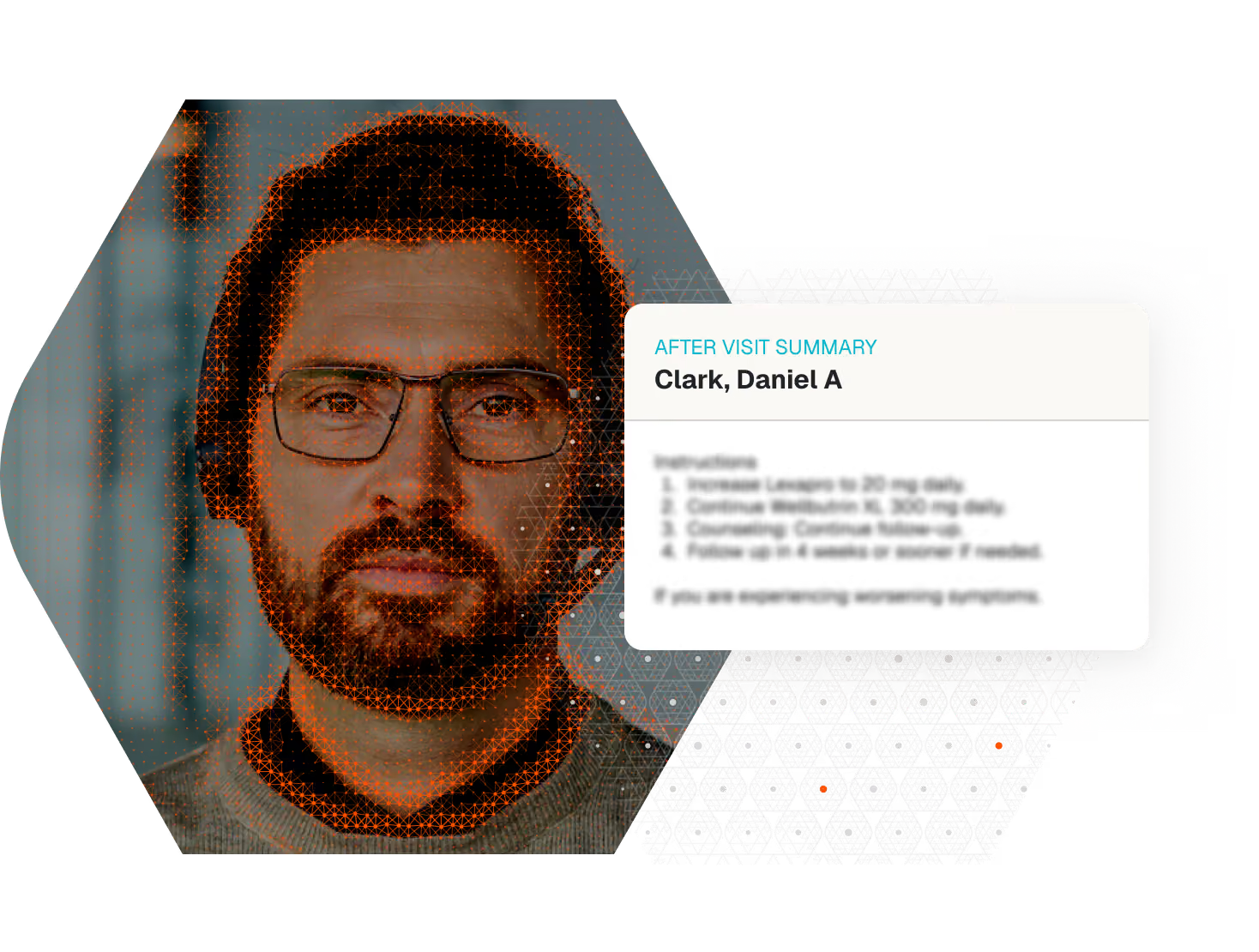
Healthcare is under attack. Bad actors use AI to impersonate patients, providers, and employees at scale. Each voice or video interaction is a potential exposure point that can lead to PHI breaches, fraud, and a damaged reputation.
A PHI breach is one phone call away
Deepfakes impersonate patients to collect and access PHI. The result? Access in the wrong hands, with PHI, claims data, account information, and compliance on the line.


Bots are probing the IVR right now
Automated bots use stolen PII to validate accounts and stage takeovers across HSA, eligibility, claims, and prescription workflows. By the time losses surface, the takeover has already happened.


Friction is a security failure too
Legacy measures, like knowledge-based authentication, frustrate real patients in moments of stress, and still let attackers through. Meanwhile, bots flood your support lines, eating up agent capacity. Handle times climb while satisfaction and care both slip.


Verify identity. Prioritize care. Build trust.
AI-powered attacks have rendered traditional authentication ineffective. Verify the person in real-time to neutralize AI threats and defend your patients, data, and reputation.
Catch attacks before a data breach
Detect synthetic attackers before they access and expose sensitive data.
Reduce fraud
Identify risky callers to help prevent benefits abuse, account recon, and other fraudulent activities.
Defend care delivery & patient experience
Tighten security, streamline the patient experience.
THE PRODUCTS BEHIND IT
Powered by the Pindrop Platform
Pindrop technology enables healthcare enterprises to answer three key questions in order to detect AI-powered attacks: Is this identity human? Is this identity risky? Is this identity known?


Report
Five AI attacks hiding in the channels you trust
AI-driven attacks grew nearly 14x in under two years. Security leaders from Fortune 500 enterprises mapped where the risk actually lives. See the five threats that topped their list.
Digital trust isn't optional—it's essential
Take the first step toward a safer, more secure future for your business.

Healthcare FAQs
Three patterns are common. AI-powered staff impersonations calling helpdesks to social engineer credential resets. Bots probing IVRs at scale to validate patient information and stage account takeovers. Outdated security measures for patient and member authentication that frustrate real people while still letting attackers through. The Pindrop platform addresses all three patterns.
AI cloning has made it routine to spoof IT staff, vendors, and clinical personnel on the phone. Once a helpdesk grants a credential reset, the attacker walks straight into clinical systems. Deepfake-assisted candidates can produce the same outcome through hiring, with legitimate credentials issued on day one.4
Knowledge-based authentication is bypassed more than 50% of the time. One-time passcodes are bypassed about 25% of the time. Attackers already know the answers your authentication questions ask about.3
Not on its own. Voice biometric systems verify that a caller sounds like a known enrollee. AI voice clones can bypass voice profile matching, at low cost and at scale. It’s also worth noting that voice biometrics typically authenticate on one factor: a matching voice profile. Additional signals are needed to analyze a more complete picture of who is calling: device data, VoIP anomalies, spoofed ANI, behavioral patterns, etc.
Yes. The Pindrop PulseⓇ solution detects synthetic and AI-generated voices in roughly 2 seconds with 99% accuracy at <1% false positives.5 Pulse for Meetings extends the same protection into Zoom, Teams, and Webex.
The Pindrop solution integrates natively with Genesys Cloud CX, NICE CXone, Five9, Webex Contact Center, and Zoom Contact Center. Meeting protection runs through Webex by Cisco, Zoom Meetings, and Microsoft Teams.
Start with a risk assessment. We will walk your team through the specific attack patterns hitting your IVR, helpdesk, and patient and member services lines, then map them to Pulse, Protect, and Passport coverage. Talk to a real human today →
Disclaimer
- Based on Pindrop customer data from Q4 2024-Q1 2026. Derived from a study of over 700M calls.
- Pindrop, How Real-Time Bot Detection Shut Down 94.3% of IVR Attacks at a Fortune 500 Healthcare Org, case study, May 2025 - April 2026.
- Pindrop, 2025 Voice Intelligence and Security Report, June 12, 2025.
- For more examples, review Pindrop, The Year Trust Broke: Inside the AI Fraud Spike, January 2026.
- Pindrop internal data and testing analysis, 2026