Articles

Joint Alert on North Korean IT Workers

July 31, 2026
Author
Katelyn Halbert
Market Intelligence
Joint Alert on North Korean IT Workers

TL;DR 

  • This is an identity, access, and insider-risk issue. The alert says North Korean IT workers obtain false identities, secure remote work, and remit earnings to parent North Korean agencies. Once inside a company, they may also be involved in data exfiltration, cryptocurrency theft, and theft of sensitive information.
  • AI attack growth is accelerating fast. Pindrop’s analysis of AI fraud data shows AI-driven attacks growing roughly 7X faster than traditional attacks from the end of 2024 through Q1 2026, a 1,390% increase.1
  • The warning signs are distributed across teams. Recruiters may see interview discrepancies. HR may see document or identity mismatches. Finance may see unusual payment details. Security may see location and account anomalies. No single function has the complete picture.
  • An interview is one control, not conclusive proof of identity. The alert lists in-person interviews as one example of stronger verification for online platforms, but it also warns that third-party proxies may participate in interviews or even establish in-person contact.
  • Pindrop’s broader interpretation is that live identity deserves ongoing scrutiny. In high-risk virtual interactions, organizations need more than credentials and visual familiarity to assess whether a participant is a real human, the right human, and connecting from the expected location.

On July 31, 2026, agencies from 11 countries issued a warning that North Korean IT workers are using false identities, third-party proxies, location-masking tools, and artificial intelligence to obtain work through online employment, procurement, and contracting platforms.

The timing is not surprising. Gartner reported in August 2025 that two out of three organizations have already been hit by a deepfake.

The alert describes a specific state-backed revenue scheme. It also exposes a broader enterprise security gap: a false identity can move through an ordinary hiring process and become trusted access.

The governments recommend stronger identity verification and suspicious-account detection. They do not prescribe continuous identity verification or endorse a particular technology. Pindrop’s view is that the warning signs show why identity assurance should not be treated as a single checkpoint that ends once a candidate is hired.

What the joint alert says

The alert was issued by agencies from the United States, Japan, the Republic of Korea, the United Kingdom, Australia, Canada, New Zealand, France, Germany, Italy, and the Netherlands, as reflected in the joint publication. It follows earlier warnings from individual governments and multilateral groups about North Korean IT worker activity, and enforcement is already underway. In a statement accompanying the alert, the FBI said eight individuals have been sentenced to prison in 2026 alone for their roles in these schemes.

According to the alert, North Korea relies on a network of skilled IT workers, both inside and outside the country, to obtain false identities and earn income remotely. These workers impersonate nationals of other countries to secure employment or contracts, then remit their salaries to parent North Korean agencies to help fund the country’s unlawful nuclear weapons and ballistic missile programs.

The alert describes several parts of the operating model:

  • Workers may falsify their nationality or identity, forge identification documents, or use images of documents supplied by third parties.
  • Third-party proxies may create online accounts, participate in job interviews, or establish in-person contact to build trust and obtain work.
  • Workers may conceal their true locations with proxies, virtual private networks, remote desktop software, and laptop farms.
  • They may avoid direct deposit, request payment through money-transfer services or cryptocurrency, or use a third party’s bank account.
  • They may use AI, translation services, or large language models to obscure their identities and produce more convincing profiles and communications.
  • Once hired, they may create insider risk involving data exfiltration, cryptocurrency theft, or theft of sensitive information.

The alert also warns that contracting with and paying North Korean IT workers may violate domestic law in some countries and may result in legal consequences or financial penalties. For organizations, the exposure may therefore extend across security, sanctions, compliance, financial crime, and employment processes.

What Is a Laptop Farm?

A laptop farm is an arrangement in which a third-party facilitator receives a company-issued computer and enables a worker in another location to access it remotely. The company may then see activity that appears to originate from the laptop’s physical location, while the person performing the work is somewhere else.

The July 31 alert says North Korean IT workers are known to use overseas facilitators, including facilitators in the United States, to receive company laptops and help obscure the workers’ true locations.

The Red Flags, and Who Actually Sees Them

The joint alert identifies warning signs for companies operating online platforms and for organizations hiring or procuring services. The second and third columns below are Pindrop’s analysis of where those signals may surface and which team may encounter them first.

Red flag from the alertWhere it surfacesWho sees it first
ID documents look forged or edited with image softwareOnboarding document reviewRecruiting or HR
Photo ID mismatch, or a video feed that appears manipulated or AI-generatedLive video interviewRecruiters or hiring managers
Refusal to appear on camera
Interview schedulingRecruiters or the interviewing team
Profile errors or unnatural phrasing consistent with machine translationApplication reviewRecruiters
Name on the account does not match the payment accountPayroll or payment setupHR or finance
Frequent changes to contact, account, or banking detailsAccount maintenanceHR, finance, platform ops
Same ID document or IP address across multiple accountsPlatform telemetryPlatform trust and safety or security
Signs one account is operated by different people at different hoursOngoing workManagers or security
Below-market rates, or requests for payment in cryptocurrencyNegotiation and paymentProcurement or finance

No single indicator establishes fraud. Several indicators, considered together and supported by additional evidence, may warrant further review.

These controls should be applied through consistent, documented, and risk-based procedures. Warning signs should not be used as proxies for nationality, ethnicity, accent, disability, or country of origin. In the United States, the Equal Employment Opportunity Commission states that Title VII protects applicants and employees from national-origin discrimination, including treatment based on country of origin, ethnicity, or accent. Legitimate applicants may use VPNs, speak with an accent, request accommodations, experience technical problems, or display other characteristics that have innocent explanations.

In-person interviews are one control, not proof

The alert encourages companies operating online platforms to strengthen identity verification through measures such as strict review of identification documents and in-person interviews. That recommendation deserves attention, but it should not be interpreted as proof that physical presence resolves every identity question.

There is a reason for that caution. Research from King’s College London and the Center for Strategic and International Studies, published in Communications of the ACM, found that people distinguish AI-generated media from authentic media at roughly 50% accuracy, essentially a coin toss. A recruiter or hiring manager watching a video interview has no reliable way to know, in the moment, whether what they are seeing is real.

The same alert warns that third-party proxies may participate in job interviews and may even establish in-person contact to create a false sense of trust. An in-person interaction can add evidence, but it is still one control within a layered process.

The FBI’s Internet Crime Complaint Center raised a related concern in a June 2022 public service announcement, when it warned that complaints involved deepfakes, voice spoofing, and stolen personal information in applications for remote work. Some complaints described interview video in which the person’s movements did not fully align with the audio.

The practical lesson is not that remote hiring must end. It is that organizations should not rely on a document, a credential, a background check, an in-person meeting, or a video call as conclusive proof on its own. Stronger assurance comes from combining independent signals and creating a defined path for escalation when those signals conflict.

What this looks like in practice

A recent Pindrop case illustrates the pattern. A candidate appeared over synthetic video in one interview. In a later interview, the candidate’s location signals did not match what had been claimed on the resume. Neither interview looked obviously wrong on its own. It was only by comparing identity signals across both interactions that the mismatch became visible, which is exactly the kind of pattern a single point-in-time check cannot catch.

The identity gap extends beyond recruiting

The July 31 alert is specifically about North Korean IT workers and the legal, financial, and security risks associated with that program. The actor and sanctions context matter.

The control implications are also broader. The tactics described in the alert rely on false identities, third-party proxies, synthetic or manipulated media, location concealment, and fragmented ownership across business functions. Those methods are not inherently limited to one threat actor.

Hiring is therefore not only a talent process. It is an enterprise identity-security boundary.

Recruiting evaluates a candidate. HR validates documents and completes onboarding. Finance establishes payment. IT provisions devices and accounts. Security monitors access. When each team sees only one part of the identity, inconsistencies can pass between systems without becoming a coherent risk signal.
That creates a difficult question after access has been granted: Is the person doing the work the same person who was interviewed and verified?

A traditional onboarding check can establish that an identity cleared a process at a specific moment. It cannot, by itself, confirm who is participating in a later interview, meeting, approval, or sensitive conversation.

Applying Zero Trust to live identity

Security teams already apply Zero Trust principles to users, devices, applications, and access decisions. Live conversations are often treated differently. A valid meeting account and a familiar face or voice may be accepted as sufficient evidence that a participant is who they claim to be.

Pindrop’s position is that high-risk virtual interactions deserve a more continuous model of identity assurance.

Continuous identity verification evaluates identity signals throughout a live interaction rather than relying only on a one-time check. In Pindrop’s framework, that means assessing:

1.

Is this identity synthetic?

Assess whether the participant is a real human. Liveness detection, deepfake analysis, and behavioral biometrics are applied to voice and video throughout the interaction, not only at session start.

2.

Is this identity risky?

Assess whether the context matches expectations. Device telemetry, geolocation, and behavioral baselines are compared against established patterns in real time, so anomalies surface during the interaction rather than after it.

3.

Is this identity known?

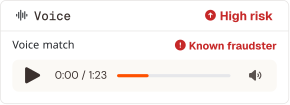
Assess whether this is the right human, the same person who was interviewed and verified before. Identity signals are matched across sessions, so a substitution between interactions becomes visible.

This is Pindrop’s security framework, not a recommendation stated in the joint alert. The connection is that the alert identifies manipulated video, identity discrepancies, account sharing, VPN use, and location concealment as potential indicators. Those signals can emerge during live interactions as well as during onboarding.

Where Pindrop Pulse® for Meetings fits

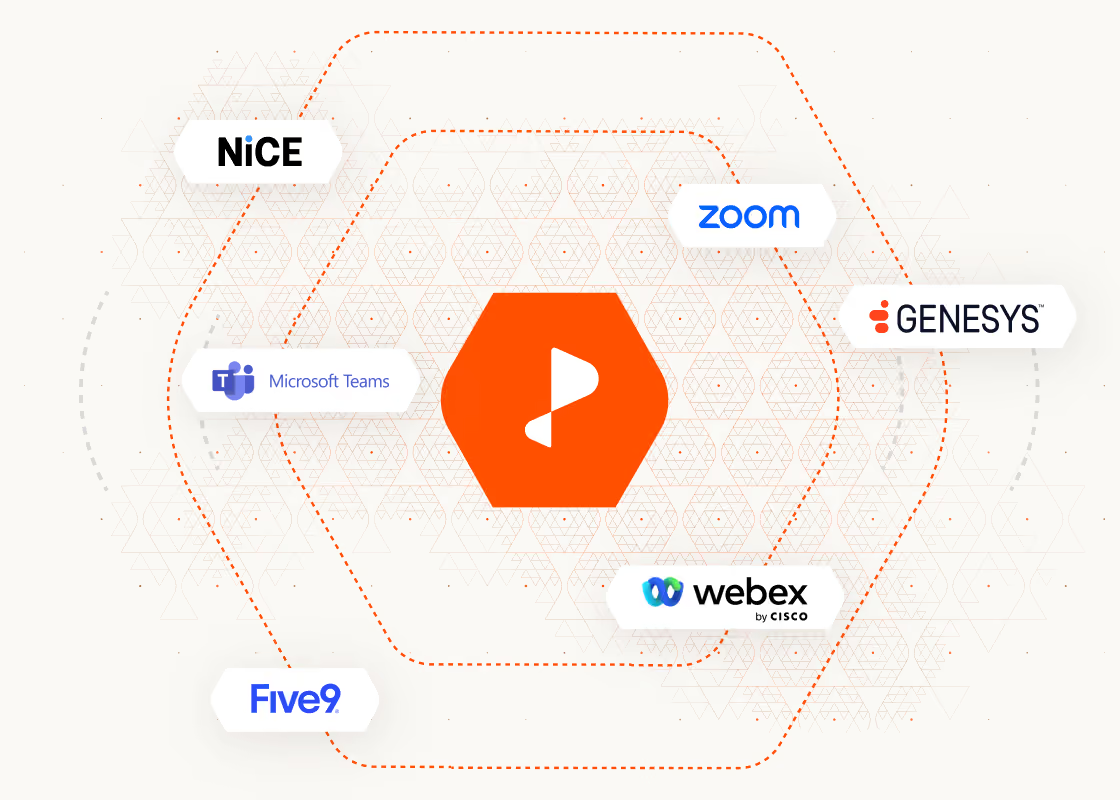
Pindrop Pulse® for Meetings continuously evaluates identity signals during virtual meetings. It analyzes live audio and video for signs of synthetic manipulation, supports passive voice authentication, and surfaces location-related risk indicators such as VPN use or unexpected geographies.

In the context of the joint alert, Pulse addresses a defined part of the problem: identity risk inside live virtual interactions, including manipulated or artificially generated meeting media. It does not replace document verification, background screening, access controls, sanctions review, employment-law compliance, or incident response.

Pulse also does not treat one signal as proof of malicious activity. It provides additional context so security teams can assess participant identity and determine the appropriate response under their own policies and governance processes.

Questions security leaders should ask

  1. How do we verify identity during remote hiring, and which parts of that verification continue after onboarding?
  2. How would we detect that the person doing the work is not the person we interviewed?
    What happens when a recruiter, hiring manager, or procurement leader identifies an identity discrepancy?
  3. Can HR, recruiting, finance, platform operations, and security connect signals associated with the same person or account?
  4. Are contractor and vendor identities held to the same standard as employee identities?
  5. Which high-risk meetings require stronger participant verification before access, funds, or sensitive information are approved?
  6. Do our procedures distinguish between a risk indicator and evidence of fraud?
  7. Are our controls documented and applied consistently without relying on nationality, accent, ethnicity, or other protected characteristics?

Summary

The July 31 joint alert documents a specific North Korean effort to use false identities, proxies, location-masking tools, and AI to obtain remote IT work and generate revenue. It also shows why hiring fraud cannot hiring fraud cannot be treated as a recruiting-only problem. It is an enterprise security problem.

The signals span the entire relationship, from profile creation and interviewing to payment, account activity, location, and ongoing access. No single control or team can see the full pattern alone.

Pindrop’s broader conclusion is that organizations should treat identity as an ongoing security question, particularly during high-risk live interactions where trust can lead directly to access, information, or financial authority.

Meet us at Black Hat

Frequently asked questions

The U.S. State Department and FBI, with agencies from ten allied countries, warned that North Korean IT workers use false identities to get hired through online employment and contracting platforms, then send their earnings to North Korea to fund its weapons programs. Once hired, they can act as insider threats. The FBI noted that eight individuals have already been sentenced to prison in 2026 for their roles in these schemes.

Workers falsify nationality and identity, often with forged or borrowed identification documents. They use third-party proxies to open accounts and sit for interviews, hide their locations with VPNs and remote desktop tools, rely on laptop farms run by facilitators abroad, and typically request payment by money transfer or cryptocurrency.

Hiring is the entry point. If a fake identity clears the interview and onboarding, it gains legitimate access to systems and data. Most of the alert’s warning signs surface inside the hiring process, before security is ever involved.

Not reliably with the human eye. The FBI first warned of deepfakes in remote job interviews in June 2022, when lip-sync errors were still a visible tell. The 2026 alert describes video feeds that appear manipulated or artificially generated, and the visuals have grown harder to catch, which is why detection is shifting to real-time analysis of the media signal itself.

The practice of confirming, in real time and throughout an interaction, that the person you are dealing with is a real human and the specific person they claim to be, across voice, video, and digital channels. It treats identity as an ongoing signal rather than a one-time check.

No. The alert describes a specific state program, but the method, faking an identity to get hired remotely, is available to any capable actor. The broader lesson is about the fragility of one-time identity checks in remote hiring.

Source:

1Pindrop analysis of AI fraud data, Q4 2024 to Q1 2026. 

Digital trust isn’t
optional—it’s essential

Take the first step toward a safer, more secure future for your business.