


Article

Nicholas Holland on Building Trust in the Age of AI

logo
Sindu Jacob

Head of PR & Corporate Communications • June 9, 2026 (UPDATED ON June 9, 2026)

8 minutes read time

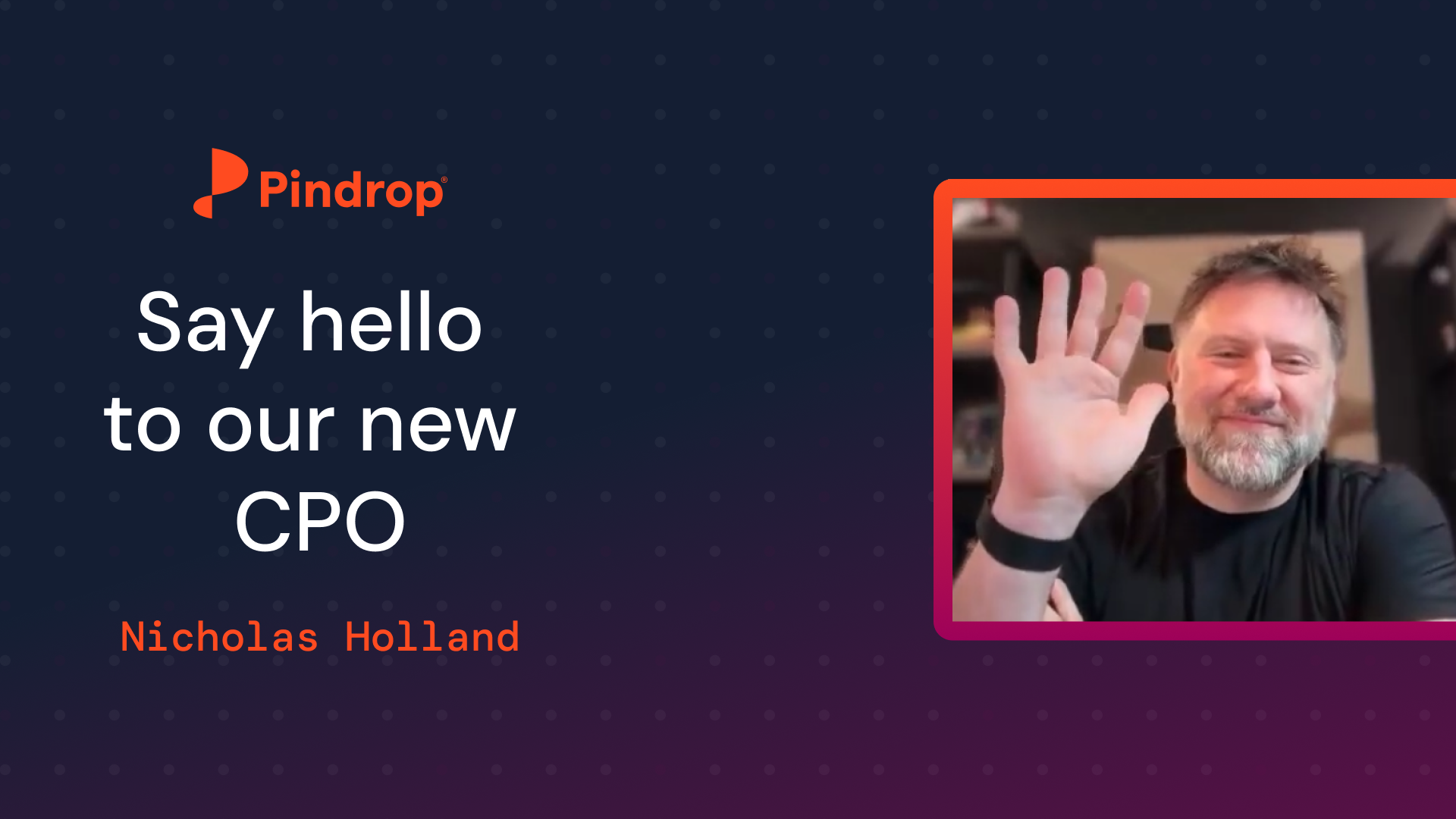
Watch an interview with Pindrop's new CPO Nicholas Holland on why trust is the defining challenge of the AI era—and how Pindrop is building trust for real-time communications.

Inside a fireside chat with Pindrop’s new Chief Product Officer

When Nicholas Holland talks about AI, he does not begin with models, features or roadmaps. He begins with trust.

At a time when synthetic voices can sound human, deepfakes can manipulate perception, and AI agents are beginning to act on behalf of people and businesses, trust is quickly becoming one of the defining challenges of the AI era.

“Over the last decade, we focused on connecting people and systems. The next decade is about deciding what and who you can trust.”
Nicholas Holland
Nicholas Holland, Chief Product Officer, Pindrop

That challenge is exactly what drew him to Pindrop.

As Pindrop’s new Chief Product Officer, Nicholas brings more than two decades of experience across AI, cybersecurity, identity and communications. Most recently, he helped shape AI product strategy at HubSpot, where AI adoption scaled across more than 250,000 organizations.

Now, he is focused on a much bigger opportunity: helping Pindrop build the trust infrastructure for real-time communications.

Why Pindrop, why now

For Nicholas, joining Pindrop was not just a career decision. It was deeply personal.

He believes AI has the power to dramatically improve the world. He has also seen how quickly it can be weaponized. His grandmother was targeted by a scam. His son encountered deepfake content online. Those experiences reinforced something he already believed: trust can not be treated as a background assumption in digital interactions.

“I think AI can be a force for good,” Nicholas said. “But right now, it is flirting pretty heavily with being a force for negativity.”

That is what made Pindrop’s mission resonate.

“Every day, we get to wake up and be AI crime fighters. If we do a good job, we make the world a better place.”
Nicholas Holland
Nicholas Holland, Chief Product Officer, Pindrop

One platform. One trust story.

One of the first things that stood out to Nicholas during the interview process was the simplicity of Pindrop’s mission.

“We are a trust layer for real-time communications,” he said.

That idea now shapes how he thinks about the future of the company. Rather than viewing Pulse, Protect, Passport and emerging capabilities as separate products, Nicholas sees the opportunity to create a more unified platform experience, one where customers can solve a meaningful problem quickly and naturally expand across the broader Pindrop platform over time.

“I want us to have one vision for Pindrop. Not separate product stories. One story.”
Nicholas Holland
Nicholas Holland, Chief Product Officer, Pindrop

The future of trust: entity, intent and action

Nicholas frames the future of trust around three core questions:

  • Is this the right entity?
  • Do they have the right intent?
  • Are we enabling the right action?

For years, identity has been the center of security. In a world shaped by AI-generated content, synthetic identities and autonomous agents, identity alone does not provide enough context.

That shift becomes even more important as customer interactions move across voice, video, chat, mobile, web and emerging agent-driven channels. “Anywhere businesses interact with customers, they are going to want to know: is this synthetic, is this risky and is this really my customer?” Nicholas said.

The same challenge exists inside the enterprise.

“Is this a machine? Is this risky? Is this really my employee?” Nicholas says.

Building for an agentic future

Nicholas believes one of the biggest opportunities ahead is agentic cybersecurity.

As AI agents become more capable, they will increasingly complete tasks on behalf of consumers and businesses, from verifying insurance benefits to resolving support requests and handling administrative workflows. Some of those agents will create enormous value. Others may be deceptive, fraudulent or malicious.

That creates an entirely new trust challenge.

“If agents are going to be everywhere, how do you know which ones are good and which ones are not? Organizations can govern agents inside their own walls, but trust breaks down when agents interact across enterprises. Creating trust in that ecosystem is a gap where Pindrop is uniquely positioned to solve.”
Nicholas Holland
Nicholas Holland, Chief Product Officer, Pindrop

Pindrop approaches agentic security from two complementary angles. First, we help organizations defend against increasingly sophisticated third-party AI agents that can leverage voice, video and other digital channels to impersonate individuals, manipulate interactions and commit fraud. Second, we are applying agentic AI within our own security workflows to strengthen fraud detection and investigation capabilities.

Products like Fraud Assist already demonstrate this vision in action, helping analysts review calls, summarize activity, and accelerate investigations. We’re expanding these capabilities with more advanced security-focused agents that can analyze patterns across large volumes of interactions, connect signals across multiple cases over extended periods of time and surface emerging fraud trends that may be difficult for human analysts to detect on their own. By combining protection against external AI-driven threats with AI-powered investigative capabilities, Pindrop is building a more proactive and intelligent approach to enterprise security.

Building once, scaling everywhere

To support that future, Nicholas believes Pindrop must continue evolving how it builds products. He sees an opportunity to create more shared capabilities across signals, interfaces, reporting, workflows and customer experiences. “We should build once and gain leverage across multiple products,” he said.

That platform mindset is about more than efficiency.

It creates consistency for customers, accelerates innovation and gives teams the ability to scale with greater focus. Nicholas is also thinking deeply about pricing, packaging and long-term product strategy. He believes great products are built around clear customer value, not feature accumulation.

“There is a common problem in Product organizations: the belief that if you build it, they will come,” he said. “You have to understand where the customers are and how you are going to reach them.”

Crafting the future at startup speed

Internally, Nicholas is focused on building what he calls a “Camelot product org” — a culture defined by clarity, pride, speed and craft.

That means strong onboarding, clear operating principles, sharper roadmap processes and tighter collaboration across product, engineering and design. He wants teams to challenge assumptions, stay grounded in first principles and move with urgency. “’There is no spoon,’” Nicholas said, referencing the sci-fi movie The Matrix. “It’s a reminder to challenge assumptions. Our job is to focus on the problem, not be limited by how things have always been done. If someone says, ‘We’ve never done it that way,’ that’s an opportunity to find a better way.”

For Nicholas, speed and quality are deeply connected.

“Slow is smooth and smooth is fast,” he said. “Speed does not mean reckless.”

The road ahead

Nicholas sees Pindrop continuing to build on its leadership in voice intelligence, biometrics, risk and fraud detection while expanding the technologies and expertise that made it a leader in voice into new channels and use cases. What began as a voice-focused company has evolved to secure interactions across video, digital and emerging AI-driven experiences. He sees a future where Pindrop extends its impact across more channels, more industries and more interactions between people, businesses and AI agents, helping establish trust and security wherever those connections occur.

But for him, success is ultimately measured by impact.

“I am really enamored by the concept of the number of souls we protect. How many people and interactions can we restore trust to?”
Nicholas Holland
Nicholas Holland, Chief Product Officer, Pindrop

That ambition reflects the next chapter for Pindrop.

A future where trust is intelligently established in every interaction. Where businesses can engage with confidence, employees can act with certainty and customers can connect without hesitation, even in a world transformed by AI.

Because as digital and human interactions become increasingly indistinguishable, one question will define the next era of technology:

Can you trust who — or what — is on the other end?

Digital trust isn’t
optional—it’s essential

Take the first step toward a safer, more secure future for your business.