

AI ATTACKS

The six high-cost AI attacks every CISO needs to know

May 26, 2026

Here’s what AI attacks actually look like

Discussions about AI-powered attacks happen behind closed doors, tucked away in internal incident reports and confined to candid exchanges between peers at industry conferences. This secrecy leaves security leaders with an near-impossible task: responding to threats they can’t see.

That’s why we’re breaking down the anatomy of AI attacks: what they look like, how they work, and why they’re able to slip past traditional defenses.

Here are the stakes: A multi-million dollar wire transfer after a deepfake video call.1 A North Korean operative moving through your hiring pipeline.2 An IT helpdesk handing over SSO credentials to someone posing as an employee.3

Attacks like this are playing out at companies everywhere, everyday. And with AI-driven attacks growing by nearly 14x in six quarters,4 organizations can’t afford to treat this as low-risk threat.

The scams are here. Is your security strategy ready for them?

fake job candidates attack surface

Fake job candidates

executive attack surface

Executive impersonation

helpdesk attack surface

IT helpdesk attacks

Contact center attack surface

Contact center attacks

vendor attack surface

Vendor or partner impersonation

wealth management attack surface

Wealth management scams

AI has forced security leaders to doubt the channels they trust

Talk to a CISO right now and one word keeps coming up: uncertainty. Uncertainty about how AI attacks will reshape security strategies. Uncertainty about where to invest. Uncertainty about where the real risk even lives.

That’s exactly why we created the CISO Deepfake Defense Council.The Council brings together a select group of highly regarded security executives from seven Fortune 500 enterprises and other category-leading organizations across a broad cross-section of industries, including technology, financial services, healthcare, life sciences, defense, enterprise software, cryptocurrency, and cybersecurity. The Council is focused on delivering strategic guidance to help enterprises understand, prepare for, and defend against deepfakes—one of the fastest-emerging threats to trust and identity.

We interviewed these leaders individually and as a group, probing to understand how they’re thinking about the new enterprise threat landscape.

Takeaways from the CISO Deepfake Defense Council

Unauthorized access is just one step in a longer attack chain

Impersonation (deepfakes or otherwise) opens the door. Once a bad actor gets in, they become an insider threat, often with the access they need to cause system-wide damage.

Telling the difference between a good bot and bad bot is about to be critical

As companies incorporate AI into their workflows and authorized agents begin handling tasks, companies will need a way to discern what is an approved use of AI and what is suspicious, unauthorized activity.

Attackers are playing in blindspots

It’s nearly impossible to defend against what you can’t see. That’s why bad actors attack the channels that seem low-risk or protected (e.g., hiring or vendor comms). Without visibility, leaders can struggle to calculate exposure.

Perceived weak points vary across industries

One security leader points to helpdesk impersonation as a critical risk, another points to contact center attacks. This variation seems to be driven by industry-specific priorities. For example, financial services may prioritize high-risk customer or client interactions that can end in direct financial losses. Leaders from other industries may perceive different interactions as more vulnerable.

Companies need detection that works with them, not against them

Adoption of deepfake detection needs to integrate seamlessly into existing workflows. Roadblocks will directly impact whether people utilize the tool when its needed.
“A healthy immune system needs to be proactive, anticipating threats before they attack. In the age of deepfakes, enterprises need to approach defense in the same way: building their cybersecurity strategy for resilience and adaptability.”
Jim Roth quote image
Jim Routh
Chairman of The CISO Deepfake Defense Council and former 6X CSO/CISO in financial services and healthcare

How CISOs think about the new threat landscape

Council members mapped AI attacks by reputational and financial risk. Answers varied, but six threats rose to the top.5 This briefing covers those six.

New threat landscape

Where do these attacks land on the risk exposure grid for your organization? Download a blank version and bring this exercise back to your team.

Sources and disclaimers

1 CNN, “Finance worker pays out $25 million after video call with deepfake ‘chief financial officer’,” February 2024.
2 Pindrop, “From Interview to Intel Drop: The Moment We Exposed a Coordinated Hiring Scheme,” July 2025
3 Pindrop, “How Pindrop Technology Could’ve Prevented the MGM Breach,” September 2023.
4 Based on Pindrop customer data from Q4 2024-Q1 2026. Derived from a study of over 700M calls.
5 Compiled based on five anonymous mapping exercises with security leaders from the CISO Deepfake Defense Council.

FAKE JOB CANDIDATES

How AI helps fake job candidates get hired

Attackers use synthetic identities and real-time deepfakes that help them pass interviews to land on your payroll.
fake job candidates hero

Your applicant pool is full of potential insider threats

In 2025, the FBI released an official public service announcement warning about North Korean operatives trying to get hired at U.S.-based companies.¹ These operatives use fabricated or stolen identities to apply for jobs, funneling salaries back to the regime while conducting espionage from inside company walls.

Deepfake applicants show up with polished resumes, credible LinkedIn® profiles,2 and impressive work history, and when they log on for an interview, they seem well-prepared and professional. But these fake candidates often use real-time face-swap tools trained on photos, sometimes scraped from real people’s social media, filtered or manipulated voices, and work references that lead to companies that don’t exist or can’t be verified.

The consequences of hiring a fake candidate can be severe. Once inside a company’s systems, a fraudulent employee can steal data and intellectual property, or plant backdoors for future exploitation. Companies that unknowingly pay these workers may also find themselves in violation of federal sanctions laws. And being infiltrated by a state-sponsored actor can erode customer trust and bring unwanted scrutiny.

Stat image 1

1 in 343

job applicants were linked to North Korea in Pindrop’s study in 2025.3
Stat image 2

1 in 47

job applicants were linked to North Korea in Pindrop’s study in 2026.4
Stat image 3

630% increase

in DPRK-linked job applicants for Pindrop in just one year.5
Real world Case study

“Jamie” was likely a North Korean operative

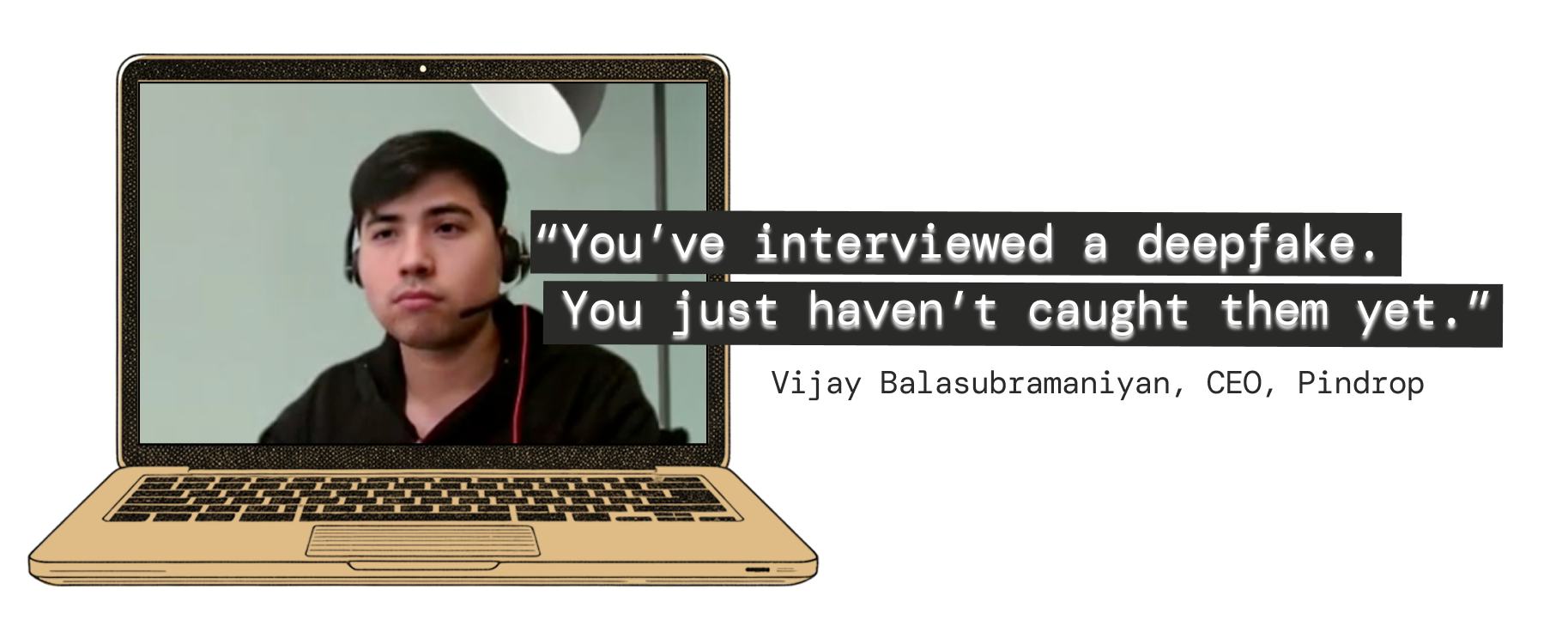
In early 2025, Pindrop started investigating fake job candidates. Since then, the deepfakes have only gotten more convincing. Case in point: “Jamie,” a candidate for Pindrop’s Senior Software Engineer role.

Jamie had clear answers, a polished delivery, and seemed well-prepared. It took a Pindrop Pulse® for meetings alert to raise concerns. Without it, he likely would have moved forward. Pindrop later linked Jamie’s IP address to North Korea.

Jamie

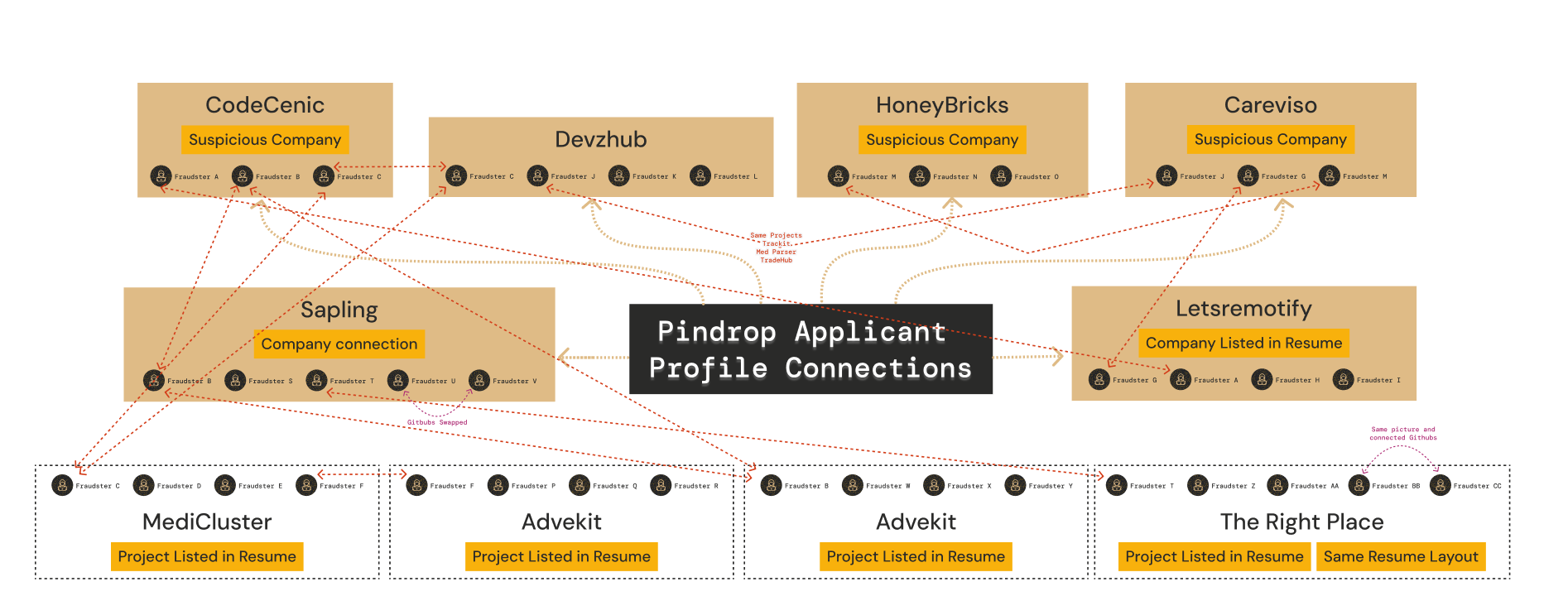
Pindrop researchers also noticed patterns in device telemetry, geography and network characteristics, email patterns, and synthetic identity construction amongst fake candidates. By extracting attributes from a confirmed fraudulent candidate, they built a relational graph of past applicants—and found that one confirmed fake applicant helped uncover a web of 23 past candidates with similar patterns.

One fake candidate. A whole web of fraudulent applicants.
Additional web of applicants
Image CTA
Don’t wait for a fake job candidate to slip past your defenses

Take action today. Download the Deepfake Readiness Checklist.

Sources and disclaimers

1FBI, “North Korean IT Worker Threats to U.S. Businesses,” July 2025.
2LinkedIn is a registered trademark of LinkedIn Corporation and its affiliates in the United States and/or other countries.
3Pindrop, “From Interview to Intel Drop: The Moment We Exposed a Coordinated Hiring Scheme,” July 2025. Based on Pindrop’s 2025 internal investigation of applicants for two remote roles.
4Based on Pindrop’s 2026 internal investigation of applicants for a Senior Software Engineer role.
5Comparison of Pindrop’s 2025 internal investigation and 2026 internal investigation.

Contact center attacks

Attackers continue to exploit trust in contact centers

AI helps attackers automate their schemes, speeding up account takeovers and compounding losses.
cotact center attack hero

How the manipulation scam works

This sharp rise in AI-driven attacks is happening in contact centers, where companies often still rely on knowledge-based authentication questions to verify identity.

The attack chain is simple: impersonate a customer, pass the authentication check, and takeover the account. And authentication is often easy to pass with data from breaches. Now with AI, these attackers can increase their operations exponentially, inundating contact centers with a high volume of attacks.

increase
in AI attacks in just six quarters.1

60x growth

in AI attacks per day¹
An average 287 AI attacks per day across our customer base, a staggering 6400% increase from 2025.

8.7% of all fraud

is AI-backed in contact centers as of Q1 2026¹
This is up from the prior year, when <1% of fraud in the contact center was non-live.

And when it works, the damage hits fast. Funds are drained before the customer even knows their account has been touched. For the organization, that means fraud losses, costly incident reviews, and reputational damage. In an industry where trust is everything, a wave of successful account takeovers can do lasting damage.

Bot calls are getting more realistic fast.
Listen to these real-world calls from last year. Can you tell the difference?
Citations

1 Based on Pindrop customer data analysis from Q1 2026 in comparison to the previous five quarters.

Executive impersonation

Your exec team is an easy impersonation target.

Attackers use AI to study and replicate executives’ voices and faces—creating convincing clones in seconds.
Exec impersonation hero

Weaponizing authority for deception

When an employee gets a suspicious email, security training tells them to verify through a different channel. But when they join a video call and see a face they recognize, that feels like verification. Even though it isn’t. In the AI era, seeing and hearing someone is no longer proof that they’re real, and most employees don’t know that yet.

Executive impersonation is happening now, and virtual meetings are one of the biggest blind spots enterprises have. A cloned voice or face in a meeting carries the same authority as the real thing, and in many cases, nobody in that room can tell the difference. A random text asking for gift cards is easy to dismiss, but a call that sounds and looks identical to your CEO? That’s much harder to ignore.

Real world example

According to a 2025 PSA from the FBI,1 bad actors have been impersonating government officials, including Cabinet members and members of Congress, to gain unauthorized access since 2023. These attackers send AI-generated voice messages and texts, posing as senior U.S. officials to build rapport with targets before manipulating them for their own gain.

In the summer of 2025, an AI-generated voice clone impersonating Secretary of State Marco Rubio successfully reached senior U.S. officials and foreign ministers.2 Just a synthetic voice lifelike enough to pass as a high-ranking government official.

These same tactics are already being used against corporations. Anyone in a position of authority or influence is an impersonation target. Fake CEOs releasing financial documents, making public announcements, manipulating an employee—all can lead to serious reputational, operational, and regulatory fallout.

Deepfake leaders can end in multi-million dollar mistakes

Think about what happens when an employee joins a meeting with their CEO who asks them to move fast on a wire transfer. The instinct is to help, to not slow things down, and to trust the person at the top. Executive impersonation works because it exploits something security training struggles to override: the instinct to comply with authority.

And the damage goes beyond manipulated employees. Fake videos of leaders making statements about financials or product updates can do serious damage to brand reputation too. Leaders have access, influence, and trust. AI lets scammers mimic all three.

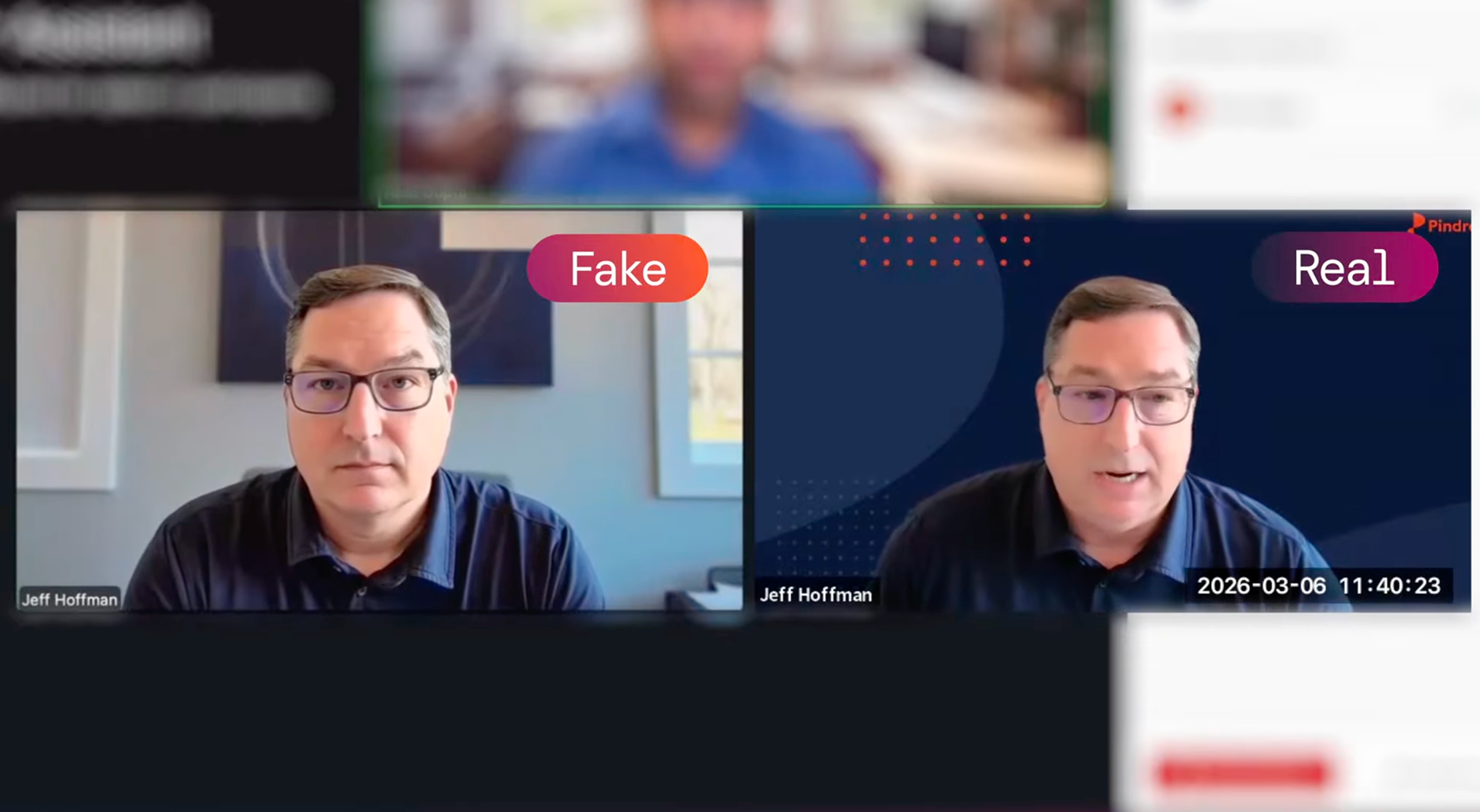
jeff deepfake video
We created a deepfake of Pindrop’s CFO to prove just how easily attackers can join meetings as a fake executive.

Real stories and real damage of fake leaders

Real stories 1
Real world example

Attackers impersonated WPP’s CEO using a fake WhatsApp account, cloned voice, and deepfake video to pressure an executive for money and sensitive information.3

Real stories 3
Real world example

Scammers ran a highly realistic Elon Musk deepfake on YouTube to promote a crypto scam. It pulled in 140,000 viewers and stayed live for hours.4

Real stories 2
Real world example

In May 2026, The Singapore Police Force released a statement about a scam involving a fake Zoom meeting impersonating Singapore’s Prime Minister and other senior government officials to solicit phony government funding. One victim wired S$4.9 million (US$3.8 million) before the scheme was uncovered.⁶

Real stories 4
Real world example

Arup lost $25 million after an employee joined a video call with what looked and sounded like their CFO. It was a deepfake, and the transfer went through before anyone caught it.5

IT helpdesk attacks

IT helpdesks are easy to overlook as a target

And that’s exactly why bad actors attack there. With one MFA reset, they can take down your entire system.
Hepdesk attack hero

How helpdesk attacks play out

Armed with basic personal data from social media and leaked credentials, most of it available for mere dollars on the dark web, attackers call in, impersonate an employee, and request an MFA reset. If the helpdesk relies on knowledge-based authentication alone, they open the door for the scammer. From there, it’s a straight path to unauthorized access, ransom, IP theft, and the ability to move anywhere in your systems.

Real world example

That’s how the Scattered Spider attack against MGM Resorts played out.1 The hackers found an MGM employee’s LinkedIn® profile,2 impersonated that employee on a call with the helpdesk, and asked for login support. From there, the hackers gained access to MGM’s internal systems.1

The damage was severe. Widespread system outage impacted systems for several days.3 Caesars Entertainment and MGM shares fell in the immediate aftermath3 and the organization faced a class action lawsuit over the protection of customer privacy.4

That was all possible through impersonation at the helpdesk.

With AI, attackers can convincingly impersonate an individual’s voice and even face to aid in their scheme. They can also use AI to automate attacks, probing at channels like the helpdesk to find vulnerabilities to exploit, turning this once-trusted channel into a wide open door for attackers.

“For thousands of years, trust was based on perception: recognizing someone’s voice or seeing someone face-to-face. We’re now in an age where trust can be synthesized. AI has changed what we think of as proof.”
Ajit quote image
Head of Fraud, Financial Crimes, and Trust Systems, HealthEquity
Ajit Gaddam
Real world example

Microsoft released a warning to employees in 2026:5 scammers are infiltrating organizations, sending Teams messages pretending to be IT or helpdesk staff, and requesting remote access to victims’ computers. Once inside, they can get access to sensitive data, systems, and IP.

Sources and disclaimers

1University of Hawaii—West O’ahu, “ALPHV: Hackers Reveal Details of MGM Cyber Attack,” October 2023.
2LinkedIn is a registered trademark of LinkedIn Corporation and its affiliates in the United States and/or other countries.
3Reuters, “MGM Resorts breached by ‘Scattered Spider’ hackers: sources,” September 2023.
4Fox5 Vegas, “MGM begins payouts in $45M data breach settlement,” December 2025.
5Tech Radar, “Microsoft issues warning over Teams helpdesk impersonation attacks – hackers are ‘blending into routine IT support activity’ by abusing remote assistance access,” April 2026.

Wealth management scams

How attackers step between clients and advisors

Wealth management scams are appealing to bad actors because, if successful, they can walk away with direct cash.
welath management scams hero

Victims are tricked by a relationship they believe is real

Bad actors build fictitious advisor or client personas, complete with robust LinkedIn® profiles,¹ fabricated credentials, and believable networks, and use them to infiltrate investor transactions. Once credibility is established, the ask follows: invest here, move funds, change account details, or redirect a wire.

This works because digital trust in high-value financial relationships is still built on perception rather than verification. A credible profile, the right language, and a warm introduction are enough.

Real world example

Case in point: a deepfake of David Rosenberg, founder of Rosenberg Research, was used to promote fake investment opportunities, with victims submitting personal details to the scammers before realizing the endorsement was AI-generated.2 According to Rosenberg, “These bots have perfected my speech, my tone, my facial features and they even use my firm’s logo. They’ll have a fake assistant ready to steal your money. It’s gotten completely out of control.”2

People with authority and expertise like Rosenberg have influence—which makes them a prime target for impersonation. AI lets these attackers impersonate either advisors or high-net worth individuals to steal funds with ease.

Real world example

A Financial Times investigation exposed an entire AI-generated investment advisory network built around a fictional advisor (“Sebastian Hatherleigh”).3 The scammer advised clients in a group WhatsApp platform4 chat with approximately 100 members.

Sources and disclaimers

1 LinkedIn is a registered trademark of LinkedIn Corporation and its affiliates in the United States and/or other countries.
2 Investment Executive, “Impersonation scams threaten advisors and their clients,” December 2025.
3 Financial Times, “Inside the elaborate online world of computer-generated scams,” February 2026.
4 WhatsApp is a trademark of Meta and its affiliates in the United States and/or other countries.

Vendor or partner impersonation

How a vendor relationship becomes a vulnerability

External partners, vendors, and suppliers are often vital for a company’s operations, which is exactly why attackers impersonate them.
Vendor or partner impersonation

Third-party relationships are invaluable—and easily manipulated

Vendor impersonation and partner impersonation are some of the most underestimated risks enterprises face right now. These are relationships built on trust, and they operate across external systems that are inherently harder to monitor and verify. Unlike internal communications, the channels aren’t as secure. An attacker posing
as a trusted supplier just needs to send a realistic email, a cloned voice message, or a fake invoice to break through defenses.

A financial institution (and Pindrop customer) believed initially they only had a problem with deepfakes in hiring. After only deploying Pindrop Pulse® for meetings to their hiring team, an employee outside their recruiting team flagged a supposed “vendor” as suspicious. They asked for access to Pulse and, within seconds, caught a deepfake.1

Real world example

A cybersecurity company reported attackers using AI to create realistic email threads and fake invoices that looked legitimate. Payments were approved and sent before anyone realized the vendor wasn’t real.2

Image CTA vendor
Humans reliably catch AI manipulation only ~50% of the time³

A coin toss. That’s how good humans are at catching deepfakes. Technology purpose-built for detection is just better at spotting deepfakes than humans. This tech looks at the subtle qualities like resonance, timbre, and facial movements that separate human media from AI.

Read the datasheet to learn how it works.

Sources and disclaimers

1 Anonymous Pindrop Pulse for meetings customer.
2 Mimecast, “BEC Campaign Using AI Generated Fake Email Threads,” August 2025.
3 Cooke, Di, et al. “As Good as a Coin Toss: Human Detection of AI-Generated Content.” Communications of the ACM, edited by , vol. 68, no. 10, Sept. 2025, pp. 100–9. Crossref, https://doi.org/10.1145/3729417.

Conclusion

The question that security leaders need to ask

It used to be: is this a fraudster? Now the question is: is this a real human?
Grid texture conclusion

For attackers, AI is becoming the force behind their operations

A single check at login means nothing when attackers can generate a convincing identity, voice, and face in real time, and enter the channels you trust. The answer is continuous identity verification: ongoing, multi-signal validation throughout every real-time interaction, every call, every remote interview, every vendor communication.

Image CTA conclusion
Leaders who've been hit already know this

Those who haven’t are running out of time to get ahead of it. The cost of waiting is a multi-million dollar wire transfer, a fraudulent new hire, or a breach that starts at your IT helpdesk.

REAL WORLD PRODUCT HERE TO HELP

Pindrop Pulse® for Meetings stops AI impostors in their tracks with real-time analysis

Recognized by TIME as one of the Top 10 Most Influential Software Companies of 2026, Pindrop Pulse® for Meetings delivers deepfake detection, participant authentication, and location intelligence across major conferencing platforms—defending critical business conversations from AI and human impersonation with industry-leading accuracy.

How Pindrop Pulse® for Meetings is different

  • Real human: Highly accurate detection of deepfakes powered by industry-leading liveness models across audio and video.
  • Right human: Only platform that passively authenticates to confirm not only that a speaker is human, but that they’re the right person.
  • Right place: Only platform that provides location intelligence, flagging risk indicators such as VPN usage or mismatched geographies.

Seamlessly integrated into meeting platforms like Zoom,1 Webex,2 and Microsoft Teams,3 Pindrop Pulse appears in the meeting as a security assistant, analyzing participants and surfacing real-time risk signals to help you confidently interact with the right attendees.

Sources and disclaimers

1Zoom and the Zoom logo are trademarks of Zoom Communications, Inc., registered in the U.S. and other countries.
2Cisco, Cisco Webex, and Webex are registered trademarks or trademarks of Cisco Systems, Inc. and/or its affiliates in the United States and certain other countries.
3Microsoft Teams is a trademark of the Microsoft group of companies.