


How to Strengthen Caller Verification When STIR/SHAKEN Falls Short

Ali Mousavi
Senior Research Scientist • December 5, 2025 (UPDATED ON December 5, 2025)
4 minutes read time
The Federal Communications Commission’s (FCC) Third-Party Rule regarding caller ID authentication shifts verification responsibilities to voice service providers (VSPs) in the call path.
While this may sound like a step toward stronger caller authentication, the real situation is more complicated. The adoption of STIR/SHAKEN—the framework designed to verify caller identity—is still inconsistent and often incomplete. As a result, large gaps remain, giving fraudsters plenty of room to operate.
A patchwork of adoption across carriers
While the FCC’s rule raises expectations for caller verification, VSPs are adopting it at varying rates. Some providers sign most of their calls, while others sign fewer. This creates a patchwork system where the strength of caller authentication depends largely on which provider handles the call.
Below are the signing rates we observed from six major VSPs1, ranked by total call volume (with VSP 1 being the largest).
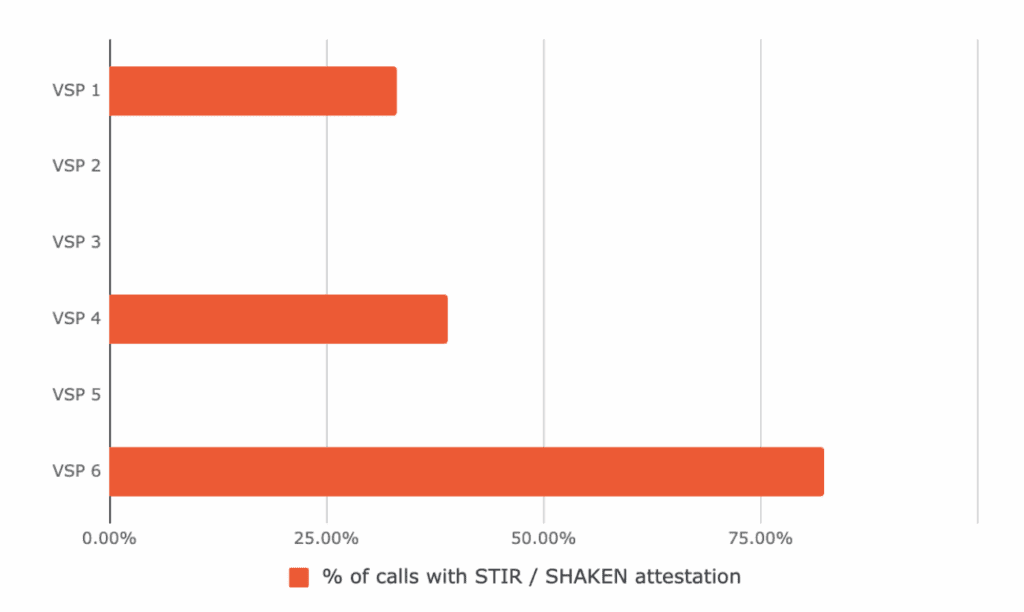
These differences highlight the challenges of relying solely on STIR/SHAKEN for caller identification. A contact center’s overall protection from fraud and spoof detection ultimately depends on the weakest VSP in their path.
Attestation levels show even bigger gaps
It’s not just the total amount of STIR/SHAKEN attestation that matters—how providers use each attestation level also exposes major inconsistencies.
STIR/SHAKEN assigns three levels of attestation:
A: Full verification
B: Partial verification
C: Pass-through as a gateway
By looking at how often providers choose each level, we can see where verification is strong and where it falls short. The A-to-B and A-to-C ratios below show how frequently a provider uses its strongest verification (A) compared to weaker ones (B and C).
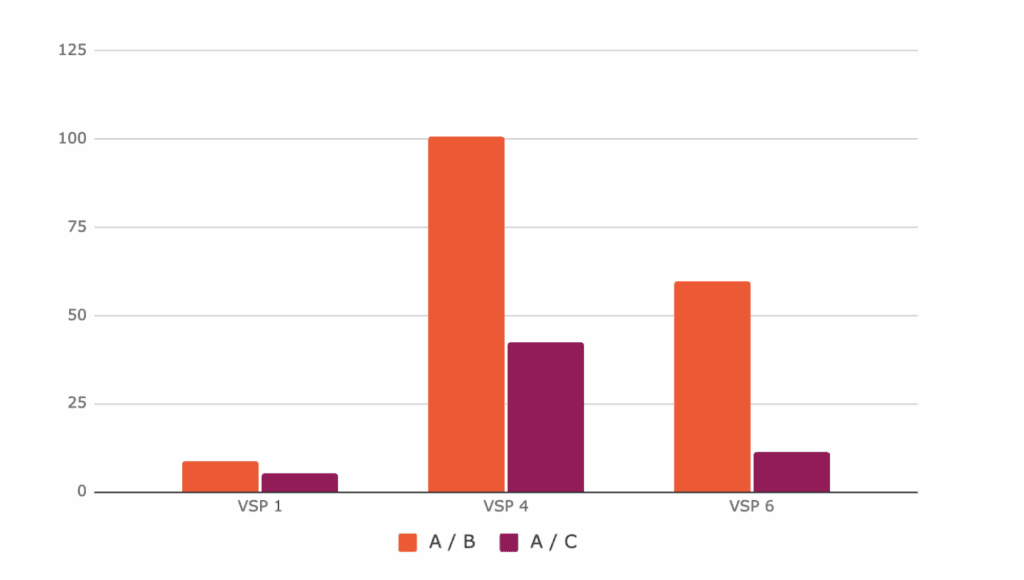
Higher ratios generally indicate stronger confidence and more established verification practices. For example, VSP 4 assigns “A” attestations at an elevated rate compared to its peers. This may reflect either strong confidence in caller identity or more permissive attestation practices.
In contrast, VSP 1’s lower ratios suggest it applies ‘A’ attestation more selectively, which can occur when a provider handles traffic from a broader mix of upstream carriers, giving it less visibility into caller identity.
These differences make one thing clear: even when overall signing rates look good, the actual quality of verification can vary widely from one provider to another.
How VSP–carrier overlap can distort industry metrics
The mix of voice service providers and originating carriers has a big impact on how STIR/SHAKEN adoption looks across the industry. Many VSPs also act as originating carriers, generating large volumes of outbound calls. When those providers have strong attestation practices, their high signing rates can make overall industry coverage seem much better than it really is.
In other words, a single large carrier with strong performance can inflate the averages and hide the low adoption among smaller or weaker performers.
Here’s how the coverage breaks down:
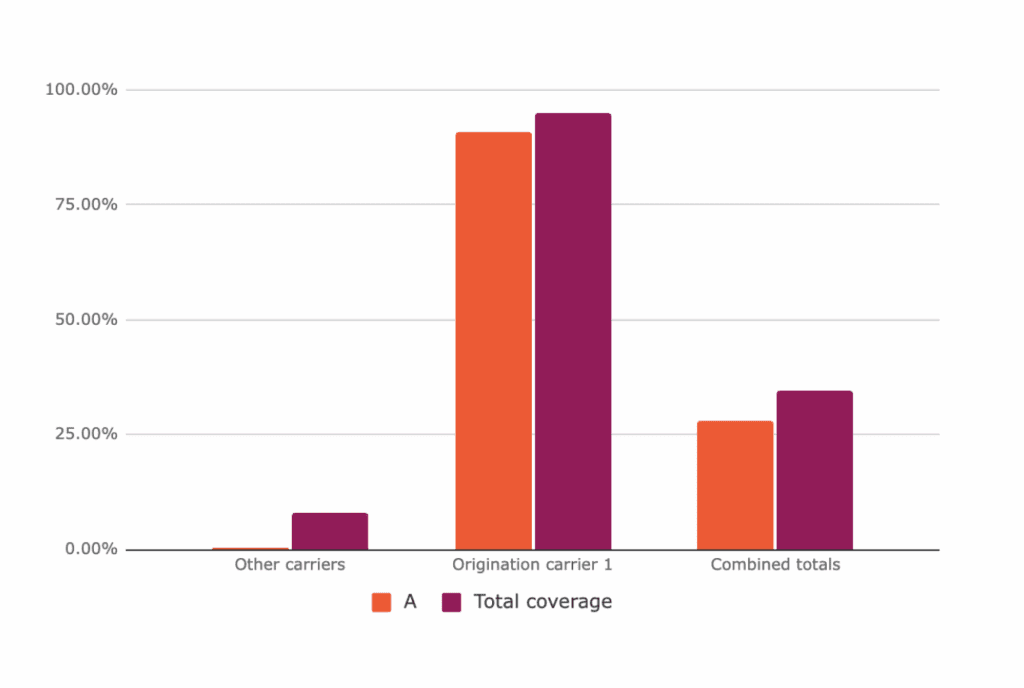
In this case, VSP 1 signs nearly all calls it originates, which dramatically boosts the combined coverage figure. However, once those calls are removed from the equation, the remaining network has coverage below 10% through the same VSP. The inflated aggregate conceals numerous gaps where spoofed or unauthenticated calls can still pass through the system.
How PindropⓇ solutions strengthen caller verification
While Pindrop solutions don’t replace a carrier’s policy verification or expand STIR/SHAKEN coverage on its own, it provides additional verification layers designed to work alongside STIR/SHAKEN authentication.
By using AI models trained on STIR/SHAKEN insights, Pindrop solutions are designed to enhance the reliability of authenticated calls when signing data is available. Pindrop’s research team developed models that can improve real-world deployments by 20%.2
When paired with Pindrop’s multifactor ANI validation, Pindrop research found that authentication accuracy rose to over 95%, adding crucial resilience on top of what STIR/SHAKEN provides.
Strengthen your caller authentication strategy with the right mix of technology and expertise. Meet with a Pindrop specialist to get started.
1 This analysis is based on a sample of approximately 20 million calls collected from a variety of providers over a 10-day period in October 2025. Results reflect only the characteristics of this sample and may not be representative of all call activity
2 Performance results referenced in this article are based on Pindrop internal testing and network analysis. Actual results may vary based on network configuration, call volume characteristics, carrier mix, and specific deployment conditions and may not represent comprehensive industry-wide patterns.
Related research + insights
Access expert research, detailed guides, and practical resources on voice security to strengthen your contact center’s defenses.

Article
How Should a Healthcare Board Address Deepfake and Voice Fraud Risk?
July 6, 20267 minutes read time

Article
The KBA Tax: What Knowledge-Based Authentication Really Costs Health Plans
June 18, 20269 minutes read time